


Why Floating Basement Floors with Water Channels Are Your Best Defense Against Leaks
Floating basement floors with water channels are one of the most effective ways to manage water seepage, hydrostatic pressure, and moisture in below-grade spaces — without tearing up your foundation.
Here’s a quick overview of how they work:
| Element | What It Does |
|---|---|
| Floating slab | Concrete floor not connected to foundation footings, allowing independent movement |
| Perimeter gap | 1-inch space around the slab edge that acts as a natural relief path for water |
| Water channels | Grooves or baseboard systems that collect seeping water and direct it to a drain |
| Sump pump | Receives collected water and pumps it safely away from your home |
| Dimpled membrane | HDPE underlayment that creates an 8mm air gap for drainage, ventilation, and insulation |
If your basement floods after heavy rain, or you notice musty smells and damp floors, you’re dealing with a very common problem. Groundwater builds up outside your foundation and pushes inward — this is called hydrostatic pressure. Left unmanaged, it forces moisture through even the thickest concrete slabs.
The good news? A properly designed subfloor drainage system can capture that water before it causes damage — and do it without compromising your home’s structural integrity.
Finishing a basement often feels like the final step in unlocking your home’s full potential. But that dream quickly runs into the reality of a damp, water-prone concrete floor. The average cost of professional basement waterproofing runs between $4,000 and $8,000 — a worthwhile investment when weighed against mold remediation, structural repairs, or ruined flooring.
I’m Darin Garvey, and with over 30 years of combined experience helping Philadelphia-area homeowners solve persistent basement water problems, I’ve seen how the right approach to floating basement floors with water channels can turn a chronically wet basement into a dry, usable space. In this guide, I’ll walk you through everything you need to know — from how these systems work to which flooring and drainage solutions hold up best over time.
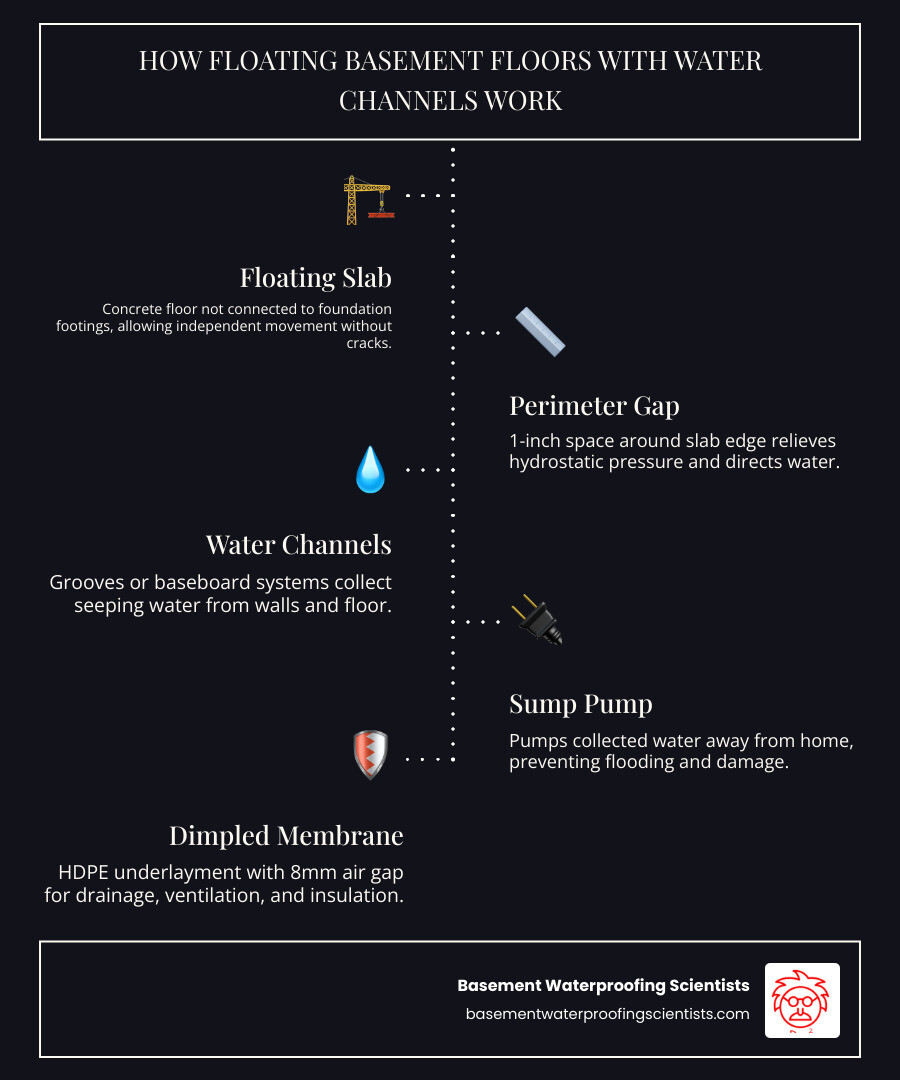
Floating basement floors with water channels vocab explained:
Understanding Floating Basement Floors with Water Channels

When we talk about floating basement floors with water channels, we are looking at a system designed to work with nature rather than against it. Most modern basements in areas like Norristown and Pottstown use what is known as a floating slab. Unlike a monolithic slab—where the floor and the foundation footings are poured as one single, continuous piece of concrete—a floating slab is poured independently.
This design creates a natural “cove joint” or a small perimeter gap where the floor meets the wall. While many homeowners see this gap and worry it’s a defect, it actually serves a vital purpose: it allows the slab to move slightly as the soil expands and contracts without cracking the foundation walls. However, this gap is also the path of least resistance for water driven by hydrostatic pressure.
By integrating basement drainage systems, we can turn this potential weakness into a strength. Instead of letting water seep across your floor, we use that perimeter gap to guide water into dedicated channels. According to discussions on Fine Homebuilding, managing this interface correctly is the difference between a dry living room and a swampy storage unit.
How Water Channels in Floating Basement Floors Handle Seepage
The “magic” happens when we give the water a place to go. Hydrostatic pressure is essentially the weight of the water in the soil pushing against your basement. If you try to simply seal the gap with caulk or hydraulic cement, the pressure will eventually find a new way in—often by cracking the center of your floor.
Instead, we use a basement water channel to relieve that pressure. As water rises under the slab or seeps through the walls, it enters the channel. These channels are sloped—typically at a rate of 1/8″ every 10 feet or a 2% grade for pipes—ensuring that gravity does the heavy lifting. The water flows through these channels directly to a sump pump, which then ejects the water safely away from your home’s foundation.
Structural Risks of Cutting Monolithic vs Floating Slabs
It is crucial to know which type of slab you have before you start any project involving floating basement floors with water channels.
- Floating Slabs: These are generally safe to modify at the edges because they aren’t tied into the structural footings. We can install drainage systems without risking the home’s stability.
- Monolithic Slabs: These are a different beast. In a monolithic foundation, the floor is part of the structural support. Cutting or breaking a monolithic slab to install a traditional French drain can be a “structural nightmare.” If you have a monolithic slab, we utilize non-destructive baseboard channels that sit on top of the floor or require only very shallow grooves (about 3/4″ deep) to maintain structural integrity.
Non-Destructive Waterproofing and the Baseboard Water Channel
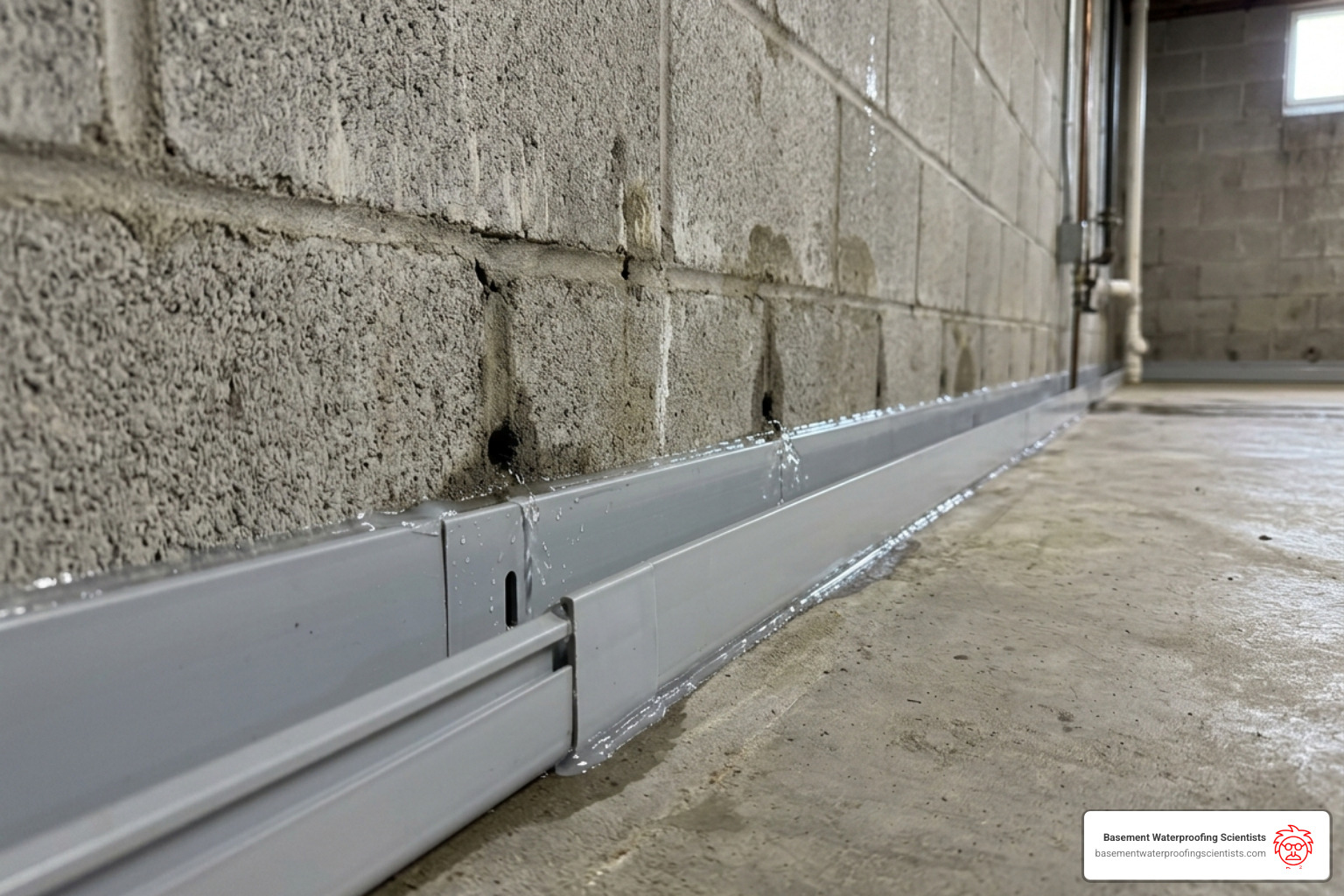
For many homeowners in Upper Darby or Bensalem, the idea of jackhammering the entire perimeter of their basement is a non-starter. This is where non-destructive waterproofing comes in. We often recommend a basement perimeter drain channel that can be installed without major demolition.
A popular version of this is the Baseboard Water Channel. Instead of digging a deep trench, we create a precision 3/4″ groove at the slab edge. We then install a high-density PVC channel that captures water from “weepholes” drilled into the bottom of the hollow foundation blocks. This system is bonded to the floor, creating a seamless, low-profile look that can even be hidden behind a finished baseboard.
Benefits of Floating Slab Foundations in 2026
As of April 2026, floating slabs remain the most cost-effective foundation choice for residential basements. They require less excavation and fewer materials than deep-footing systems. Beyond the cost, they offer:
- Flexibility: They handle soil movement better in regions with expansive clay.
- Thermal Breaks: It is easier to install rigid foam insulation under a floating slab, creating a thermal break that keeps your feet warmer.
- Drainage Integration: As we’ve discussed, the inherent perimeter gap makes them perfect candidates for interior drainage systems.
Managing the Mud Zone with Thin Floor Weeping Tiles
One challenge we often see in older homes in Philadelphia or Bristol is the “thin slab.” If your concrete is only 2 inches thick, a standard 4-inch drainage pipe won’t fit—it would stick up out of the floor like a sore thumb!
In these cases, we use specialized basement drains like the FlowGuard system. These are narrow, high-capacity channels designed to sit in front of the footing. We also address the “mud zone”—the area under the slab where fine soil can clog pipes. By surrounding our channels with clean, washed stone, we ensure that the system stays clear and functional for decades.
Best Flooring Options for Floating Basement Floors with Water Channels
Choosing the right floor to go on top of your floating basement floors with water channels is the most important decision for a finished basement. You need materials that won’t rot if they get damp.
| Material Type | Examples | Basement Suitability | Why? |
|---|---|---|---|
| Inorganic | Luxury Vinyl Plank (LVP), Ceramic Tile, PVC Tiles | Excellent | Won’t grow mold; unaffected by moisture. |
| Engineered | ThermalDry Elite Plank | Excellent | Provides a thermal break; 100% waterproof. |
| Organic | Hardwood, Carpet (without pad), Laminate | Poor | Absorbs moisture; prone to mold and warping. |
For a successful installation, we always recommend a basement drainage system that includes a dimpled membrane subfloor.
Thermal Breaks and Moisture Barriers
Concrete is like a giant, dense sponge. Even if it looks dry, it is constantly “wicking” moisture from the ground through capillary action. This is why your basement always feels a little colder and smells a little mustier than the rest of the house.
By using an insulated flooring system, such as ThermalDry, you can create a thermal break. This can make the floor surface up to 10 degrees warmer than the raw concrete. When paired with a basement tile system, you get a floor that is both comfortable and immune to mold.
Why Dimpled Subfloor Membranes are the Gold Standard
Dimpled membranes (often made of High-Density Polyethylene or HDPE) are the “secret sauce” of modern basement finishing. These membranes feature small “studs” or dimples that face down against the concrete.
- Active Air Gap: This creates a roughly 8mm (5/16 inch) air gap.
- Vapor Management: It allows moisture vapor to move and eventually find its way to the perimeter channels rather than getting trapped under your LVP or carpet.
- Condensation Prevention: The air gap acts as an insulator, preventing “sweating slab syndrome” where warm air hits cold concrete.
Installation and Maintenance of Integrated Drainage Systems
Installing floating basement floors with water channels is a precise science. At Basement Waterproofing Scientists, we follow a strict protocol to ensure long-term success. If you are a DIY enthusiast, water is relentless—a 1% error in slope can lead to standing water and odors.
Step-by-Step Guide to Non-Destructive Channel Creation
- Site Setup: We protect your home with dust barriers and floor protection.
- Groove Cutting: Using specialized dustless saws, we score a 3/4″ deep groove along the perimeter.
- Weepholes: If you have block walls, we drill small holes into the hollow cores to let trapped water out.
- Bonding: The channel is secured using high-strength adhesives or specialized fasteners.
- Sump Connection: The channel is tied into a sump pit with a 2% slope for the transition pipe.
- Customization: We add “Flush Ports” so the system can be cleaned in the future.
For more details on the heavy-duty version of this, check our guide on installing interior drain tile systems.
Long-Term Maintenance for Floating Slab Channels
Even the best system needs a little love. We recommend:
- Annual Sump Check: Test the float switch and ensure the pump isn’t leaning against the side of the pit.
- Check Valves: Ensure your check valve is working so water doesn’t flow back into the pit after the pump turns off.
- Flush Ports: Every few years, run water through the flush ports to clear out any sediment or “iron ochre” (a rusty sludge found in some PA soils).
- Radon Protection: Many of our systems include “TrenchLock” or air-sealed lids to ensure your interior drainage system maintenance doesn’t interfere with radon mitigation.
Frequently Asked Questions about Subfloor Drainage
Is it dangerous to cut a floating slab for water channels?
Generally, no. Since floating slabs are not connected to the structural footings, cutting the perimeter does not impact the stability of the walls. However, you must be careful not to cut too deep (usually no more than 3-4 inches for pipes) to avoid hitting the footing itself. We always recommend a professional inspection to confirm your slab type before starting.
How do water channels in floating basement floors prevent mold?
Mold needs three things: food (organic material), warmth, and moisture. By using water channels to remove liquid water and dimpled membranes to manage vapor, you remove the moisture component. When you combine this with inorganic flooring materials, the mold has nothing to eat and no water to drink.
What are the building code considerations for modifying floating slabs?
Local codes in places like Middletown Township often require specific permits for plumbing and drainage work. Additionally, if your area has high radon levels, your drainage system must be airtight to prevent soil gases from entering your living space. We handle all the technical requirements to ensure your system is up to code.
Conclusion
A wet basement doesn’t have to be your reality. By understanding the mechanics of floating basement floors with water channels, you can protect your home’s value and your family’s health. At Basement Waterproofing Scientists, we don’t believe in one-size-fits-all solutions. We use specialized equipment to identify the exact source of your leaks, allowing us to fix the problem for less.
Whether you’re in King of Prussia, Lansdale, or anywhere across Pennsylvania and New Jersey, we are here to help. Our work is backed by a lifetime guarantee, giving you the peace of mind that your basement will stay permanently dry. Ready to take the next step? Learn more about our professional basement drain systems and schedule your expert inspection today. Let’s make your basement magic happen!