


Understanding the Power of Gravity in Your Drainage System
When water needs to leave your home, especially from the basement, there are two main ways it can go: by gravity or by pump. Most homes use gravity for drainage.
Here’s the quick difference:
- Gravity Drain: Water flows downhill naturally. It doesn’t need electricity.
- Drain Pump: Pushes water uphill or when there’s no natural slope. It needs electricity to work.
Dealing with water in your basement can be frustrating. You want a solution that works, reliably and for the long term. That’s where understanding your home’s drainage systems comes in. At the heart of many effective water management strategies is the gravity drain. This simple yet powerful concept uses the natural pull of gravity to move water away from your property.
A gravity drain system guides wastewater or stormwater from a higher point to a lower point, without the need for mechanical pumps. It’s an energy-efficient and often maintenance-free way to manage water. But is it the right fit for your home, especially if you’re battling basement leaks? This extensive guide will break down everything you need to know about how gravity drains function, when they’re best, and when you might need a different approach.
As Darin Garvey, CEO of Basement Waterproofing Scientists, I’ve seen how crucial effective drainage is. Understanding your home’s gravity drain system is a vital step in safeguarding your basement from water issues.
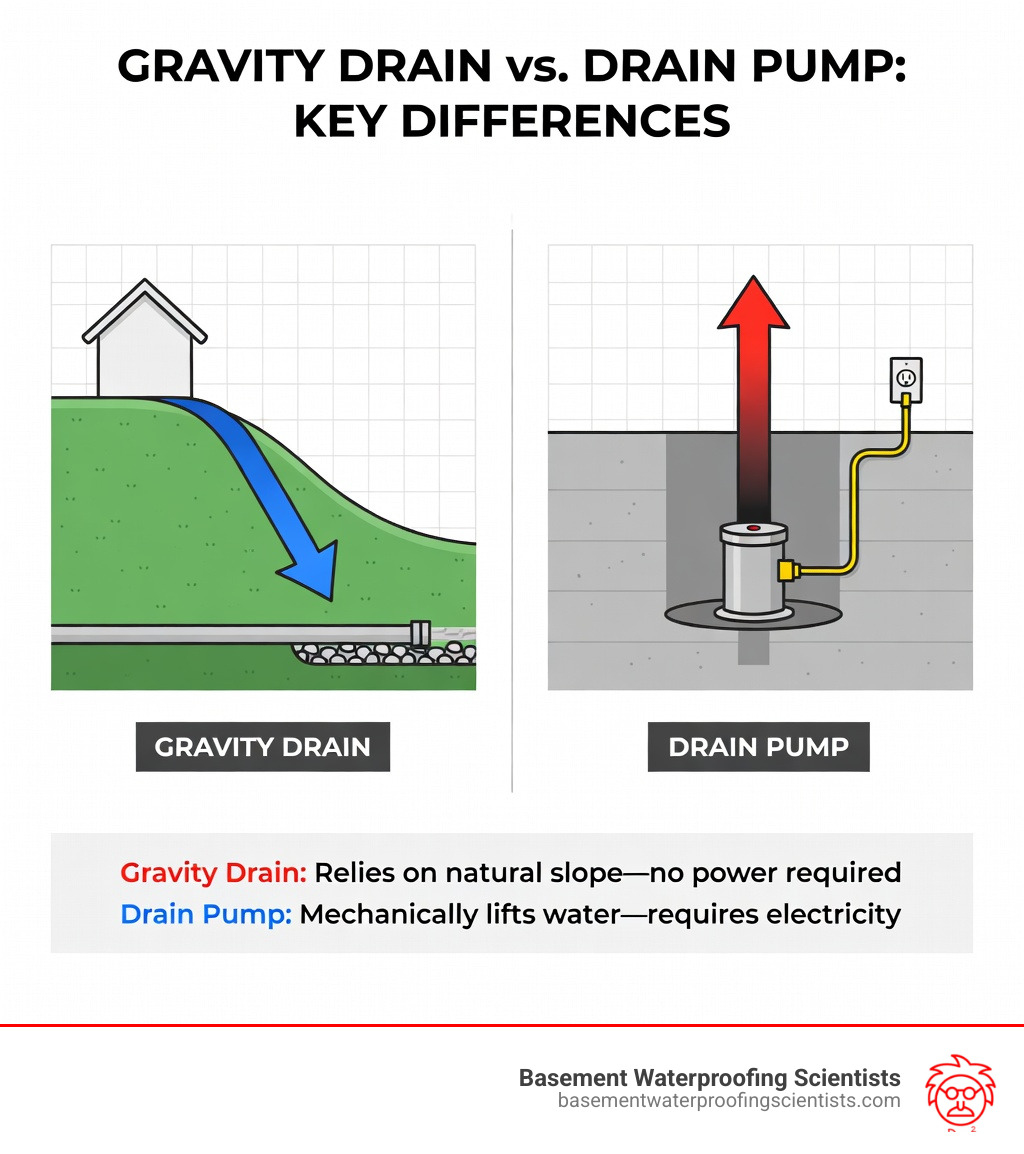
Quick gravity drain terms:
What is a Gravity Drain and How Does It Work?
At its simplest, a gravity drain is a conduit that utilizes the energy resulting from a difference in elevation to remove unwanted water. Whether it’s wastewater from your kitchen sink or groundwater pressing against your foundation in King of Prussia, gravity is the “engine” that does the heavy lifting—or rather, the heavy pulling.
According to the USGS, a gravity drain functions perfectly when the appliance’s outlet pipe sits above the waste pipe. This allows the wastewater to flow down naturally to reach the main sewer line. This movement relies on potential energy; by placing pipes at a specific natural gradient (or slope), we ensure that water always has a clear, downward path to follow.
In basement waterproofing, we use this same principle. If your home is built on a slope in a place like Reading or Norristown, we can often design a system where water collected by drainage tiles flows “to daylight” or into a municipal storm drain located at a lower elevation than your basement floor.
Gravity Flow vs. Pressurized Pump Flow
| Feature | Gravity Drain | Drain Pump (Active) |
|---|---|---|
| Energy Source | Natural Gravity | Electricity |
| Operational Cost | $0 | Monthly electricity + maintenance |
| Moving Parts | None | Motor, Impeller, Float Switch |
| Reliability | Works during power outages | Fails without backup power |
| Installation | Slope-dependent | Can move water upward |
Key Components of a Gravity System
A robust gravity drain system isn’t just a single pipe; it’s a carefully engineered network. To keep things flowing smoothly in Pennsylvania and Delaware homes, several components must work in harmony:
- Drainage Pipes: These are the veins of the system. In residential settings, we often use PVC or corrugated pipe. For municipal systems, conventional gravity sewers might use pipes with diameters exceeding 1 meter (39 inches), but your home likely uses 4-inch or 6-inch lines.
- Manholes and Inspection Chambers: These provide access points. In a city system, manholes are spaced every 300 to 600 feet. In your backyard, we might install smaller “cleanouts” so we can check for clogs.
- The Outfall: This is the destination. It might be a municipal sewer main, a septic tank, or a “daylight” exit on a hillside.
- Ventilation Points: To prevent the buildup of sewer gases and ensure smooth flow (preventing a vacuum effect), the system needs to breathe.
When a Gravity Drain is the Superior Choice
We always prefer passive water management when the geography allows it. If your property in Pottstown or Bensalem has a natural slope, a gravity drain is often the “gold standard.”
- Off-Grid Reliability: When a summer storm knocks out the power in Springfield Township, a sump pump stops working. A gravity drain keeps right on flowing.
- Lower Operational Costs: Since there’s no motor to run, your utility bill stays the same.
- Long-Term Durability: Gravity sewer infrastructure is typically designed for a 25 to 50-year lifespan. With no moving parts to burn out, the system lasts as long as the pipes stay clear.
- Energy Efficiency: It is the most environmentally friendly way to move water.
For homeowners looking to manage water in their yards, we often recommend a backyard drain tile installation that relies on these gravity principles to prevent puddling and foundation erosion.
Gravity Drains vs. Drain Pumps: Choosing the Right System
The choice between a gravity drain and a pump system usually comes down to one thing: elevation. If your basement floor is lower than the municipal sewer line—a common occurrence in flatter parts of Philadelphia—gravity simply won’t work for your sinks or toilets.
As noted by Zoeller Pumps, if an appliance’s outlet pipe sits below the waste pipe, you must use a drain pump. These pumps use force to move wastewater upward to the sewer line.
However, for basement waterproofing, the stakes are different. While a basement drain tile guide will explain how we collect water, the exit strategy is what matters. Some high-end commercial buildings even use vacuum drainage, which uses negative pressure to move water, but for 99% of homes in our service area, the battle is between gravity and the sump pump.
Limitations of Using a Gravity Drain in Basements
While we love gravity, it isn’t always an option. Here are the situations where a gravity drain might fail you:
- Flat Terrain: If your house is on a flat lot in Warminster or Upper Darby, there may not be enough “fall” to move water away from the foundation.
- High Water Table: If the groundwater level is naturally high, a gravity pipe might just fill up with water from the wrong direction.
- Silt Accumulation: Low-velocity gravity systems (slower than 2 feet per second) can allow silt and solids to settle, eventually leading to a complete blockage.
- Hydrostatic Pressure: Sometimes, the pressure of the water in the soil is so great that it needs to be actively pumped out to prevent it from cracking your floor.
In these cases, installing drain tile in crawl spaces or basements usually requires a sump pit and a reliable pump to ensure the water actually leaves the premises.
Essential Design Factors for Effective Drainage
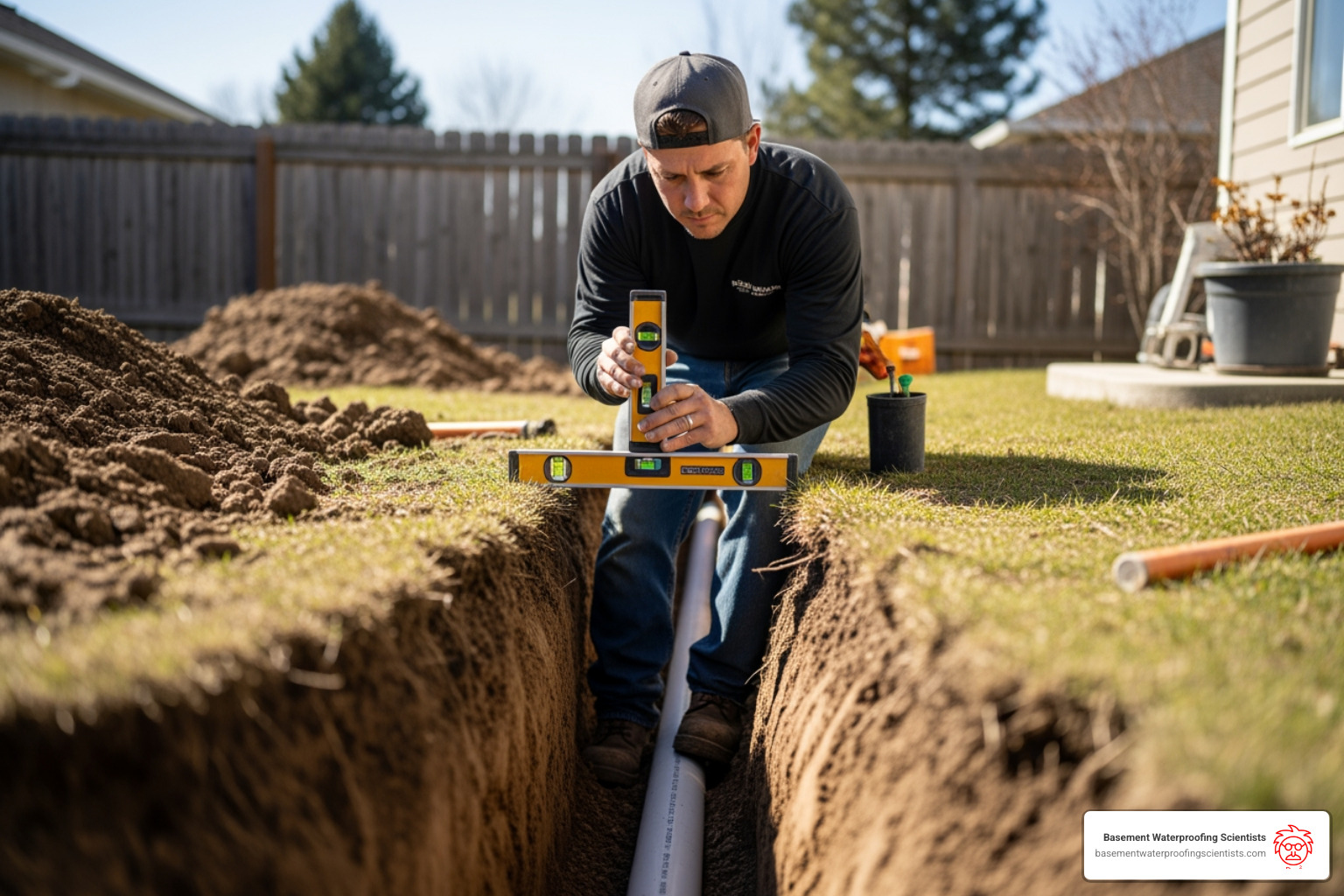
Designing a gravity drain isn’t as simple as “pointing the pipe down.” It requires precise engineering to ensure the system is “self-cleaning.”
Calculating Slope and Pipe Size
To keep solids moving and prevent clogs, a gravity drain must maintain a certain velocity.
- Minimum Velocity: To be self-cleaning, the water needs to move at least 0.6 m/s (2 feet per second) during peak flow.
- Maximum Velocity: You don’t want the water moving too fast (over 10 feet per second), as this can cause erosion and damage to the pipes.
- The “Golden Rule” of Slope: For most residential pipes, a slope of 1/4 inch per foot of pipe is the standard. If the slope is too shallow, the water stalls. If it’s too steep, the water outruns the solids, leaving them behind to create a “dam.”
According to the Ten State Standards, the minimum recommended pipe diameter for municipal gravity sewers is 200 mm (8 inches). For your home’s French drain installation, we typically use 4-inch or 6-inch pipes, which are perfectly sized for residential groundwater management.
When we look at sizing and location specifications for floor drains, we also have to consider the “head” or the depth of water that might build up on the floor before it enters the drain. A well-designed system accounts for the maximum anticipated rainfall in the Delaware Valley to ensure your basement doesn’t become a swimming pool.
Maintenance and Troubleshooting for a Gravity Drain
“Set it and forget it” is a myth. Even the best gravity drain needs a little love. In our 30 years of experience serving areas like Haverford and Radnor, we’ve seen that neglect is the leading cause of system failure.
Common Problems and Solutions
- Root Intrusion: Tree roots love the moisture inside your pipes. They can enter through tiny cracks and grow into massive blockages.
- Silt and Sediment: Over time, fine dirt particles can settle in the pipe, especially if the slope is slightly off.
- Plumber Taps: Sometimes, improper connections from other appliances can protrude into the main line, catching debris and causing “snags.”
To keep things running, we recommend:
- CCTV Inspections: We use specialized cameras to look inside your pipes and identify exactly where a leak or clog is located. This is part of how we “fix leaks for less.”
- Hydro-jetting: High-pressure water can scrub the inside of your pipes, removing roots and silt without the need for digging.
- Leaktightness Testing: For newer systems, testing gravity drains ensures that no wastewater is leaking into your foundation soil.
Regular basement French drain maintenance is the best way to ensure your lifetime guarantee remains intact and your basement stays dry.
Frequently Asked Questions about Gravity Drainage
Can I convert a pump system to a gravity drain?
It depends entirely on your property’s topography. We would need to perform a laser level assessment to see if there is a lower point on your property (or a municipal connection) that we can reach with a consistent downward slope. While the drain tile installation costs for gravity systems can be higher initially due to deeper excavation, the long-term savings are significant.
How do I know if my property has enough slope?
You can look for a “walk-out” basement or a significant drop in your yard’s elevation. However, for a precise answer, you need a professional topography assessment. We use laser leveling tools to determine if a yard drain can effectively use gravity or if a pump is required.
Do gravity drains work during power outages?
Yes! This is their primary advantage. While your neighbors in Willow Grove might be panicking about their sump pumps failing during a blackout, your gravity drain will continue to move water away from your foundation as long as the pipes are clear. For added peace of mind, many of our clients choose a “hybrid” approach: a gravity drain as the primary system with a battery-backup sump pump for extreme flooding events. This is a key part of modern basement drainage solutions.
Conclusion
At Basement Waterproofing Scientists, we believe in working with nature, not against it. Whenever possible, a gravity drain is our preferred method for keeping your home dry. It’s reliable, energy-efficient, and stands the test of time.
Whether you are in King of Prussia, Quakertown, or anywhere in the tri-state area, our team is ready to provide an expert inspection. We use specialized equipment to identify the exact source of your leaks, allowing us to provide customized solutions that often cost less than the “one-size-fits-all” approach of our competitors. With an average cost for basement waterproofing between $4K and $8K, we provide competitive pricing backed by a lifetime guarantee.
Don’t let a wet basement dampen your spirits. Protect your home with a basement drainage system designed by the scientists who know water best. Contact us today for your inspection!