

The Science Behind Basement Crack Injection
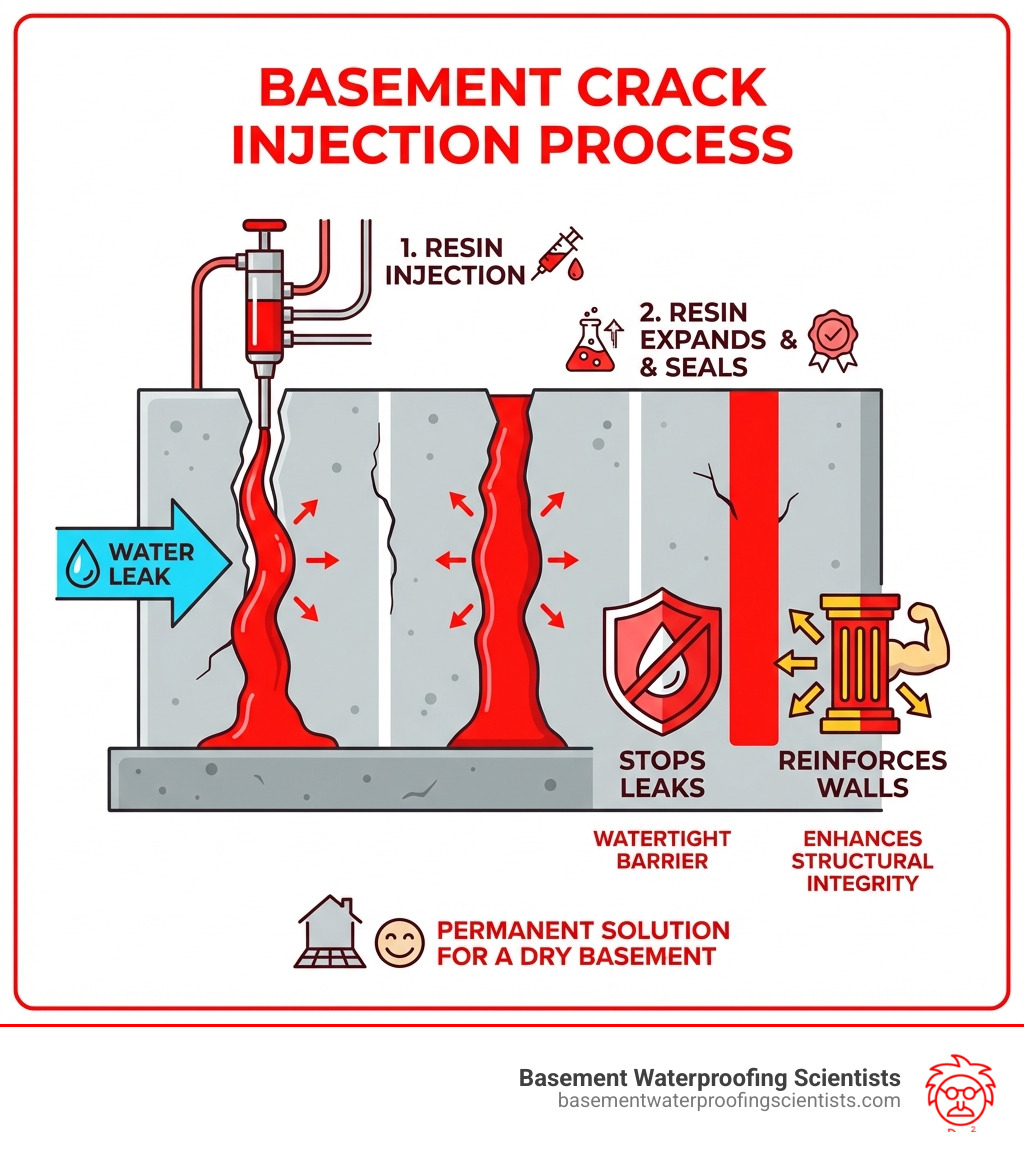
If you’re tired of persistent leaks dampening your spirits and your basement, basement crack injection offers a powerful solution to restore dryness and peace of mind. This method directly addresses foundation cracks, preventing water intrusion and protecting your home.
Here’s a quick overview of what basement crack injection involves:
- Seals Cracks: It’s a specialized technique to repair and seal cracks in your basement’s foundation walls.
- Stops Leaks: The primary goal is to prevent water from entering your basement through these cracks.
- Uses Resins: Special materials, typically epoxy or polyurethane, are injected into the cracks.
- Creates a Seal: These resins expand and/or bond, forming a permanent, watertight barrier within the crack.
- Minimally Invasive: Often, it can be done from the inside without disruptive exterior excavation.
A leaking basement can be incredibly frustrating. The constant worry about water damage, mold, and lost storage space takes a toll. This guide will help you understand how crack injection works, what materials are used, and whether a DIY kit or professional service is right for your situation. Our goal is to empower you with the knowledge to make an informed decision for a permanently dry basement.
I’m Darin Garvey, and with over 30 years of combined experience, I’ve seen how effective basement crack injection can be. My team at Basement Waterproofing Scientists specializes in targeted solutions to ensure dry, safe, and healthy basements.
Glossary for basement crack injection:
At its core, basement crack injection is a bit like performing surgery on your foundation. Most modern homes in our service areas—from Philadelphia to Reading and King of Prussia—use poured concrete foundations. While concrete is incredibly strong, it is also brittle. As it cures, it shrinks, and as the soil around your home shifts, the concrete can crack.
The science of Concrete Crack Injection for Basement Walls relies on the principle of “low-pressure” delivery. Instead of just slapping some hydraulic cement on the surface (which we call a “band-aid fix”), injection forces a liquid resin through the entire thickness of the wall.
Whether we are using epoxy or polyurethane, the goal is to travel from the inside face of the wall all the way to the outside soil. This ensures the crack is filled 100%. If you only seal the surface, water still sits inside the wall, slowly eroding the concrete and eventually popping your patch off. By filling the entire void, we eliminate the space where water can collect. You can find more info about epoxy crack injection on our specialized resource page.
When to Choose Epoxy Basement Crack Injection
Think of epoxy as “structural glue.” If your foundation crack is moving or if the structural integrity of the wall is in question, epoxy is often the hero of the story.
Epoxy resins used in basement crack injection are incredibly strong. In fact, they often boast a compressive strength of 12,000 psi or greater, which is actually stronger than the concrete itself! This is why some pros call it “concrete welding.”
You should choose epoxy when:
- The crack is “dormant” (meaning it isn’t actively leaking or growing rapidly).
- You need to restore the structural strength of the wall.
- The crack is wider than a hairline (though specialized low-viscosity epoxies can handle thin cracks too).
Technical standards, such as those found in technical notes on crack injection, emphasize that epoxy needs a dry environment to bond properly. If water is currently gushing through the crack, epoxy might not be your first choice because it won’t “set” correctly against the rushing water. For a deeper dive, check out our guide on mastering epoxy injection.
When to Choose Polyurethane Basement Crack Injection
If epoxy is the “glue,” polyurethane is the “expandable gasket.” Polyurethane is the go-to material for sealing small cracks in foundation that are actively leaking.
The magic of polyurethane lies in its reactivity. When it hits moisture, it foams up and expands—sometimes up to 20 times its original volume! This makes it perfect for filling large, hidden cavities behind the wall or sealing cracks where water is present.
Choose polyurethane when:
- The crack is actively leaking or damp.
- The crack is non-structural (meaning the wall isn’t bowing or shifting).
- You need a flexible seal that can handle minor thermal expansion and contraction of the concrete.
Polyurethane is incredibly versatile because it follows the path of least resistance, ensuring every nook and cranny of that crack is filled. It stays flexible even after it cures, which means it won’t crack again if the house “breathes” during the changing seasons in Pennsylvania and New Jersey.
How to Choose the Right Injection Kit for Your Foundation
If you’re browsing for a DIY basement crack injection kit, don’t just grab the cheapest box on the shelf. You need to match the kit to your specific problem. Here are the factors we always consider:
- Crack Width: Hairline cracks (less than 1/8 inch) require very thin, low-viscosity resins. Wider cracks (up to 1 inch) need thicker materials so the resin doesn’t just run out the back of the wall before it cures.
- Wall Thickness: Most residential foundation walls are about 8 to 10 inches thick, but some older homes in places like Norristown or Upper Darby might have thicker walls. Make sure your kit has enough yield to fill the entire depth.
- Kit Yield: A standard SikaFix or similar retail kit usually covers about 8 to 10 linear feet of a 1/8-inch wide crack. If you have a long crack or multiple cracks, you’ll need multiple kits.
- Dispensing System: We highly recommend dual-cartridge systems. These automatically mix the two parts of the resin as you squeeze the trigger, ensuring the chemical reaction is perfect every time.
For more detailed help on sizing up your project, take a look at our guide to basement wall crack repair or our technical breakdown of basement foundation wall repairing crack injection.
Step-by-Step Guide to Using a DIY Injection Kit
Ready to roll up your sleeves? Here is how to perform a basement crack injection like a pro.
1. Surface Preparation
The most common reason DIY injections fail is poor prep. You must use a wire brush to scrub the crack and the area around it (about 1-2 inches on either side). You want to remove all paint, efflorescence (that white salty powder), and loose concrete. If the crack is super tight, some people use a hammer and chisel to create a small “V-notch,” though this isn’t always necessary for low-pressure kits.
2. Installing Injection Ports
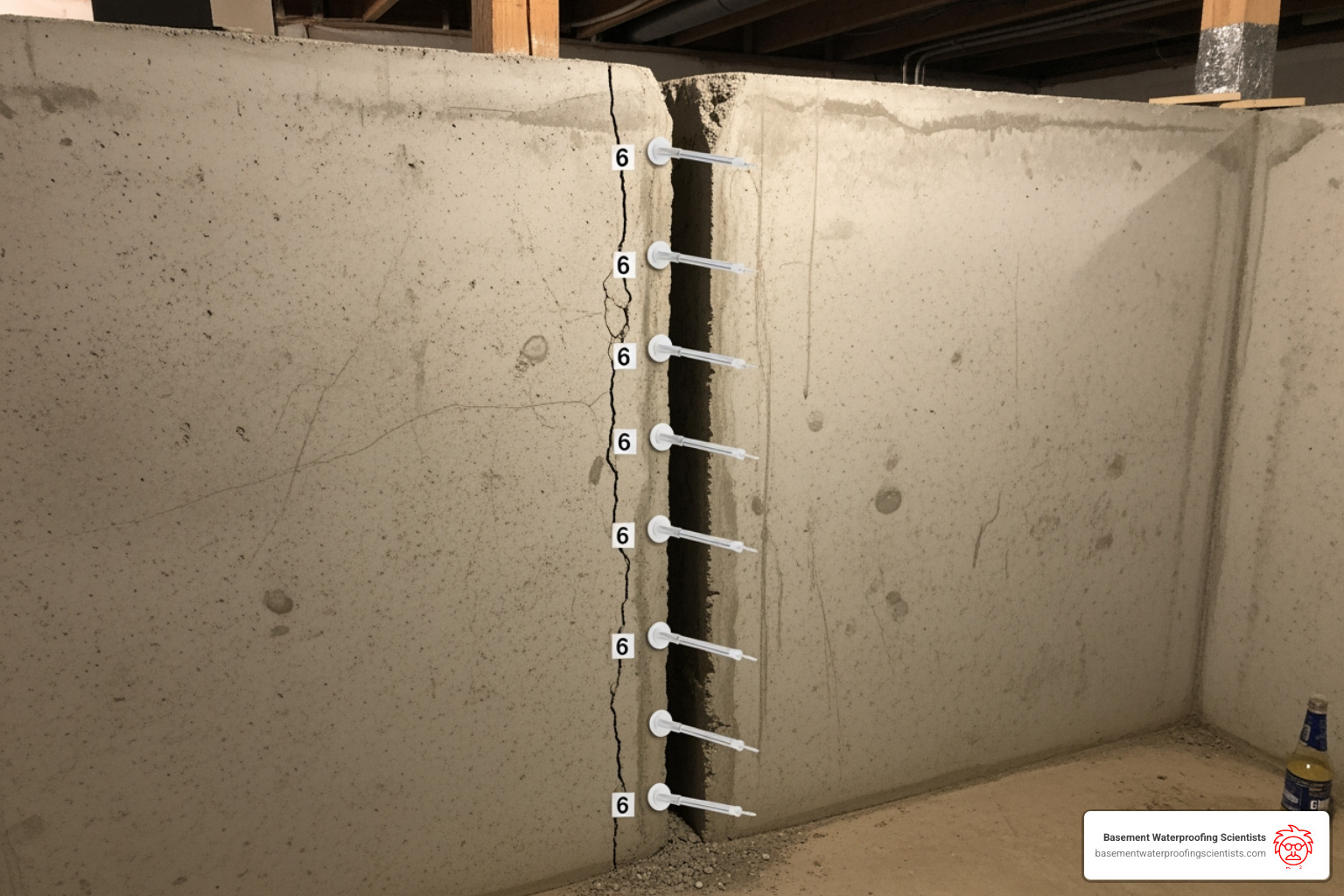
These are the little T-shaped plastic nozzles that come in your kit. You’ll glue them directly over the crack using the fast-setting epoxy paste provided.
- Port Spacing: Space them about 6 to 8 inches apart. A good rule of thumb is to space them the same distance as the thickness of your wall.
- Pro Tip: Make sure you don’t plug the actual hole of the port with the glue!
3. Sealing the Surface
Once the ports are on, you use the rest of the epoxy paste to “cap” the crack between the ports. This creates a bridge that keeps the liquid resin inside the crack during injection. Let this cure fully (usually 1-2 hours) before you start the next step.
4. Bottom-Up Injection
Always start at the lowest port. Attach your cartridge and squeeze slowly.
- The “Ooze” Rule: Inject into the bottom port until you see the resin start to ooze out of the port directly above it.
- Move Up: Cap the bottom port, move your nozzle to the next one, and repeat. This ensures you aren’t leaving any air pockets.
5. Curing and Finishing
Wait at least 24 to 48 hours for the material to cure. Once it’s hard, you can snap off the necks of the ports with a hammer and, if you’re feeling fancy, grind the surface smooth.
If this sounds like a lot of work (or a mess waiting to happen), you can always check out our foundation crack injection services to have us handle the heavy lifting.
Comparing DIY Costs vs. Professional Services
Let’s talk numbers. Everyone wants to save a buck, but in foundation repair, “cheap” can become very expensive if it fails.
| Feature | DIY Injection Kit | Professional Service (BWS) | Exterior Excavation |
|---|---|---|---|
| Cost | $75 – $225 | $500 – $2500 | $5,000 – $15,000+ |
| Time | 4 – 6 hours | 1.5 – 3 hours | 3 – 5 days |
| Warranty | None (Product only) | Lifetime Guarantee | 10 – 20 years |
| Success Rate | ~50% (for beginners) | 99%+ | High |
| Risk | High (Missed voids) | Low | High (Soil settling) |
While a DIY kit is significantly cheaper upfront, the risks are real. A common issue is a “blow-out,” where the surface seal fails and epoxy ends up all over your basement floor instead of inside the wall. Furthermore, if you have a structural issue, a DIY kit won’t fix the underlying cause.
Ignoring a crack or doing a poor repair can lead to the “escalation of costs.” Research shows that ignoring foundation damage can eventually cost up to $11,000 to fix if the wall starts to bow or collapse. There are also information on soil backfilling risks—if the soil outside was never graded correctly, even the best injection might face too much pressure.
For a more detailed breakdown of what you might expect to pay, visit our basement crack repair cost guide.
Frequently Asked Questions about Basement Crack Injection
Can I use injection on concrete block walls?
Unfortunately, no. Basement crack injection is designed for solid, poured concrete. Concrete blocks are hollow in the middle. If you try to inject resin into a block wall, the material will just fall into the hollow cores of the blocks. It’s like trying to fill a straw with a hole in the side—it just won’t work. For block walls, we usually recommend interior drainage systems or exterior waterproofing membranes.
How long does a crack injection repair last?
When done correctly with high-quality resins, an injection is considered a permanent repair. Because the resin fills the entire thickness of the wall and bonds to the concrete, it effectively becomes part of the foundation. At Basement Waterproofing Scientists, we are so confident in this method that we offer a lifetime guarantee on our professional injections.
How do I know if a crack is structural?
This is the most important question you can ask.
- Non-Structural: Vertical or diagonal cracks that are thinner than 1/8 inch are usually just “shrinkage” cracks.
- Structural: Horizontal cracks are a major red flag. They often mean the soil pressure outside is pushing the wall inward. Stair-step cracks in block walls or any crack wider than 1/4 inch also require a professional assessment.
Conclusion
Whether you decide to tackle a basement crack injection yourself or hire the pros, the most important thing is that you don’t ignore the problem. Cracks are like cavities in your teeth—they never get better on their own, and they only get more expensive to fix the longer you wait.
At Basement Waterproofing Scientists, we’ve spent 30 years perfecting the art of the dry basement. We serve homeowners across Pennsylvania, New Jersey, and Delaware with one goal: providing a permanent solution for a fair price. We use specialized equipment to find the exact source of your leak, which often allows us to fix the problem for much less than the “big box” companies who want to sell you a $15,000 system you might not need.
If you’re unsure whether that crack in your wall is a DIY project or a structural emergency, give us a call. We offer expert inspections to give you the clarity you need. Ready to stop the leaks for good? Schedule a professional basement wall crack repair with us today and let’s get your basement back to being a dry, usable space!