

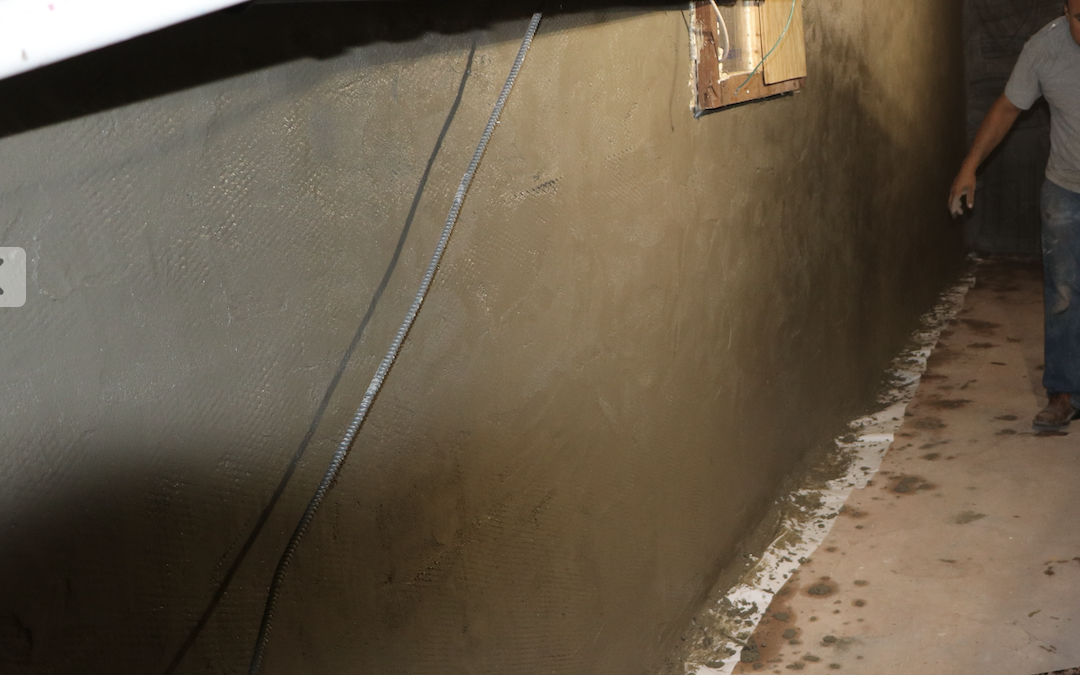
Protecting Your Home from the Outside In
Best exterior foundation waterproofing keeps water away from your basement before it ever becomes a problem. Here are the top methods:
- Liquid-Applied Membranes (Liquid Rubber) – Seamless, flexible coating that bridges cracks; lasts 20-25 years; costs $2.00-$3.50/sq ft
- Self-Adhering Sheet Membranes – Consistent thickness, excellent puncture resistance; lasts 25-30 years; costs $3.00-$5.00/sq ft
- Cementitious Coatings – Structural strength, breathable, long-lasting; lasts 25-30 years; costs $1.00-$2.00/sq ft
All three methods work best when paired with proper drainage systems like French drains and dimple boards.
Moisture affects 60% of U.S. houses, with 38% at risk for basement mold. This intrusion causes 70% of construction litigation and leads to serious structural damage. Water seeping through cracks brings mold, weakens concrete via freeze-thaw cycles, and creates hydrostatic pressure that can bow your walls.
The average repair cost is $4,000 to $8,000, not including lost living space, damaged belongings, or health issues from mold exposure.
Exterior foundation waterproofing stops water at its source. Unlike interior solutions that manage water after it enters, this method creates an external barrier between your foundation and the soil. It’s the most effective, long-lasting way to keep your basement permanently dry.
I’m Darin Garvey, and over the past 30 years, I’ve helped countless Philadelphia-area homeowners solve their basement water problems using proven best exterior foundation waterproofing methods. At Basement Waterproofing Scientists, we’ve seen how the right exterior system—properly installed—can transform a chronically wet basement into a dry, usable space for decades.
Why Exterior Waterproofing is the Gold Standard for a Dry Basement
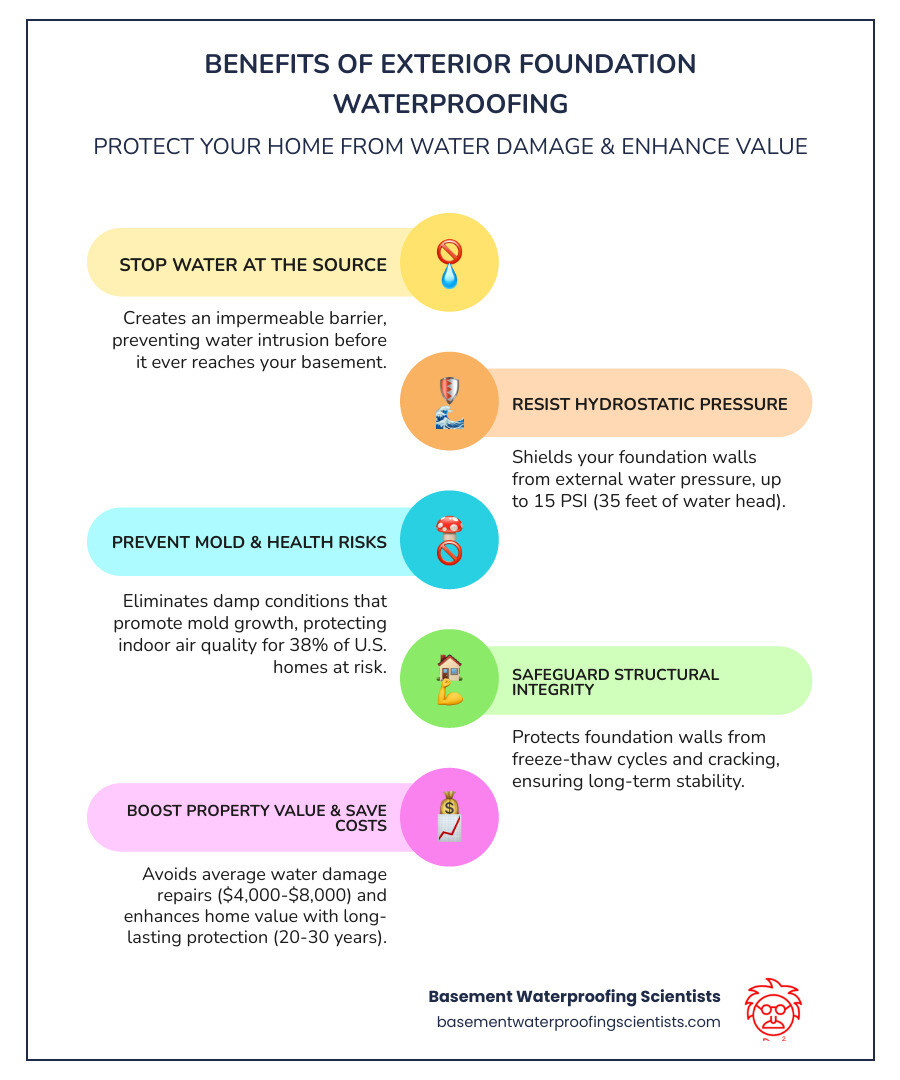
Prevention is better than a cure, which is why exterior foundation waterproofing is the gold standard for protecting your basement and home. It safeguards the very bedrock of your home’s stability. Your foundation walls constantly battle formidable forces: hydrostatic pressure, freeze-thaw cycles, and chemical attacks from the soil.
Hydrostatic pressure, the force of groundwater, pushes water through tiny cracks and porous concrete. Premium coatings are designed to resist up to 15 psi, equivalent to a 35-foot column of water, while budget coatings often fail at a mere 5 psi.
In our Pennsylvania, New Jersey, and Delaware climates, freeze-thaw cycles are a significant concern. Water expands by about 9% when it freezes, widening existing cracks and forming new ones. The best exterior foundation waterproofing systems are engineered to withstand 60 or more freeze-thaw cycles while maintaining their seal.
Aggressive soil chemistry can accelerate the deterioration of some materials, like asphalt-based systems, in as little as five years. Premium coatings, however, are formulated to resist such chemical attack for 15-25 years or more.
Investing in robust exterior waterproofing protects your property value and reduces the likelihood of costly repairs, which average between $4,000 and $8,000. By addressing the problem from the outside, you prevent these issues from ever taking root, ensuring a healthier, more valuable home. As building scientist John Straube points out, homeowners now expect basements to be dry, healthy, and usable living spaces.
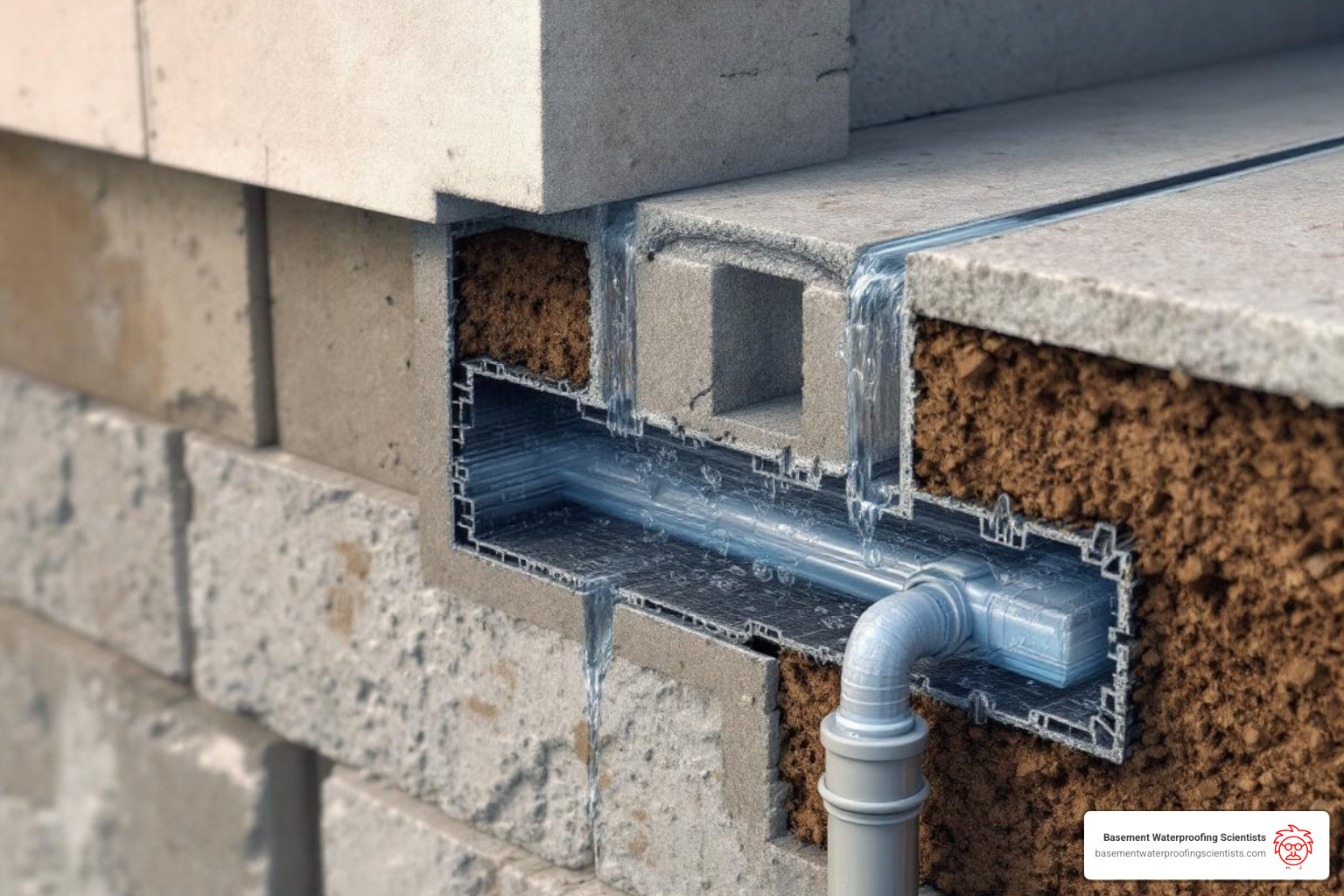
For a deeper dive into how bulk water control protects foundations, you can explore resources like the BA-1015: Bulk Water Control Methods for Foundations report. To learn more about safeguarding your home’s foundation, check out our guide on Stone Cold Protection: Waterproofing Your Exterior Foundation Walls.
Dampproofing vs. Waterproofing: A Critical Distinction
Understanding the difference between dampproofing and waterproofing is crucial. Think of it this way: dampproofing is a rain jacket, while waterproofing is a submarine. One offers far greater protection.
Dampproofing, often a thin asphaltic coating, resists soil moisture but won’t stop water under hydrostatic pressure or bridge new cracks. Building codes (like the 2021 IRC Section R406.1) often require it for well-drained soils. True waterproofing uses thicker, more flexible membranes designed to block water even under intense hydrostatic pressure and span cracks, offering real protection against basement flooding.
For more details on building code requirements for foundation protection, you can consult the official documents: More on building codes.
The Long-Term Benefits of a Proactive Approach
A proactive exterior approach is always better than managing water after it’s inside, as Peter Barrett of Dörken Systems Inc. wisely states. The long-term benefits are undeniable:
- Preventing Costly Repairs: Avoid the average $4,000 to $8,000 water damage repair bill, plus hidden costs of structural damage and mold remediation. By investing in best exterior foundation waterproofing upfront, you’re preventing these financial drains.
- Protecting Your Investment: A dry, healthy basement protects your home’s value. A well-maintained, waterproofed foundation is a key selling point for potential buyers.
- Ensuring Healthy Indoor Air Quality: Eliminate the moisture that allows mold and mildew to grow, protecting your family from poor indoor air quality and respiratory issues.
- Eliminating Efflorescence: Stop the white, powdery substance (efflorescence) on basement walls—a clear sign of moisture intrusion—by blocking water at the source.
We believe in fixing the problem, not just patching it up. Our approach ensures that your basement stays dry, healthy, and structurally sound for the long haul.
Comparing the Best Exterior Foundation Waterproofing Methods
Choosing the best exterior foundation waterproofing method involves weighing factors like cost, lifespan, and performance. After 30 years in the field, here’s a comparison of the leading methods we recommend for homes in Pennsylvania, New Jersey, and Delaware.
| Waterproofing Type | Cost (Material/sq ft) | Lifespan (Years) | DIY-Friendliness | Hydrostatic Pressure Resistance | Key Advantage |
|---|---|---|---|---|---|
| Liquid-Applied Membranes | $2.00 – $3.50 | 20-25 | Moderate | Good (15+ psi) | Seamless, highly flexible, excellent crack bridging |
| Self-Adhering Sheet Membranes | $3.00 – $5.00 | 25-30 | Moderate to Low | Excellent (15+ psi) | Consistent thickness, puncture resistant, robust |
| Cementitious Coatings | $1.00 – $2.00 | 25-30 | Moderate | Very Good (20+ psi) | Structural strength, breathable, radon barrier |
Liquid-Applied Membranes (Liquid Rubber)
Liquid-applied membranes (liquid rubber) are a top choice for best exterior foundation waterproofing due to their seamless, flexible finish. Applied as a liquid, they cure into a membrane that eliminates seams, a common leak point. With impressive elongation properties (up to 1200%), they can bridge hairline cracks that develop over time. Modern systems are low-VOC and, at a 60-mil thickness, resist hydrostatic pressure exceeding 15 psi. While DIY is possible, professional application ensures consistent thickness for a 20-25 year lifespan. Material costs typically range from $2.00 to $3.50 per square foot.
For more insights into choosing the right coating, explore our guide on the Best Exterior Foundation Coating.
Self-Adhering Sheet Membranes
Self-adhering sheet membranes are another excellent option for best exterior foundation waterproofing, valued for their factory-controlled thickness and puncture resistance, which is vital during backfilling. These rubberized asphalt or polymer rolls are pressed onto a primed foundation wall. Proper installation requires meticulous 2-3 inch overlaps at seams and corners to create a continuous barrier. They effectively resist hydrostatic pressure (often exceeding 15 psi) and have a 25-30 year lifespan. Due to the precision required, professional installation is recommended. Material costs usually fall between $3.00 and $5.00 per square foot.
For a comprehensive understanding of exterior basement wall waterproofing, refer to our Exterior Basement Wall Waterproofing Complete Guide.
Cementitious Coatings
Cementitious coatings offer a unique blend of structural strength and waterproofing. These polymer-modified cement-based slurries become an integral part of the concrete, with some forming a crystalline matrix that blocks pores and can even self-seal small cracks. They provide very good hydrostatic pressure resistance (up to 20 psi) and are breathable (around 12 perms), allowing internal vapor to escape while blocking outside water. They can also act as a radon barrier. With a lifespan often exceeding 25-30 years, they are exceptionally durable. Material costs generally range from $1.00 to $2.00 per square foot.
Learn more about specific solutions for concrete foundations in our Exterior Concrete Foundation Waterproofing article.
The Blueprint for Success: Preparation, Drainage, and Application
Achieving the best exterior foundation waterproofing requires a comprehensive system of meticulous preparation, effective drainage, and precise application. Each element is critical for success.
Essential Wall Preparation Steps
Proper preparation is non-negotiable and where many DIY attempts fail. Shortcuts here lead to costly failures.
- Excavation: First, excavate soil around the foundation down to the footing. This requires specialized equipment and adherence to OSHA safety guidelines for trenching.
- Surface Cleaning: Next, thoroughly clean the exposed walls. Use a pressure washer (3000+ psi) and appropriate cleaners to remove all dirt, loose debris, old coatings, and efflorescence.
- Repairing Cracks and Holes: Inspect and repair all cracks, voids, and form-tie holes. Use non-shrink grout or hydraulic cement for repairs. A sound substrate is critical for membrane adhesion. For more on this, see our guide on Fixing Exterior Foundation Cracks.
- Curing Time for New Concrete: For new concrete, allow it to cure for 7 to 14 days before applying most membranes, as escaping moisture can affect adhesion. Some advanced membranes can be applied to “green” concrete.
The Role of a Comprehensive Drainage System
No waterproofing system is complete without an integrated drainage solution to prevent hydrostatic pressure buildup.
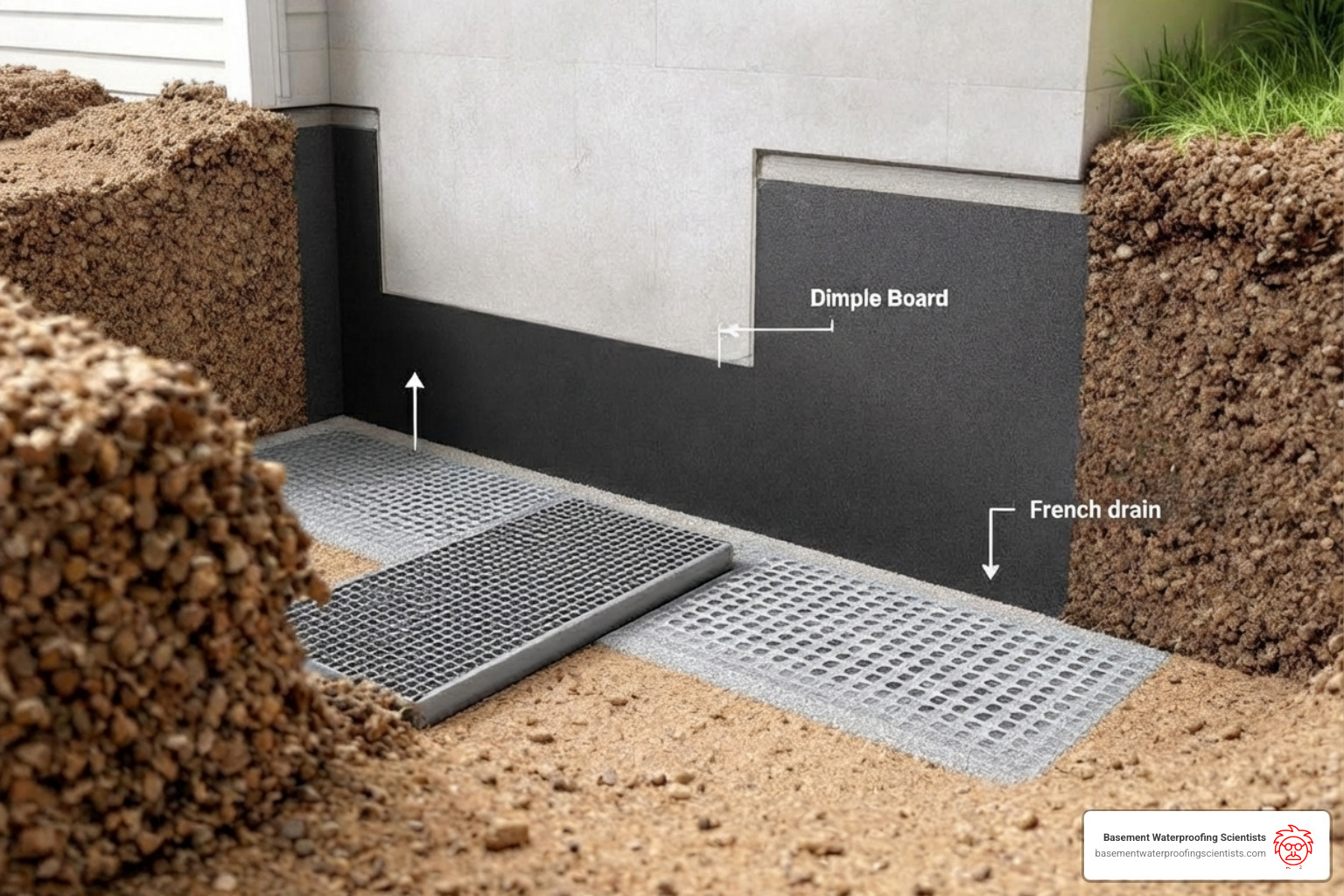
- French Drains: A French drain (a perforated pipe in a gravel-filled trench) is the workhorse of subsurface drainage. It collects and channels water away from the foundation.
- Dimple Boards (Drainage Mats): These sheets create an air gap between the membrane and backfill. This channel allows water to flow freely to the French drain and protects the membrane from punctures.
- Granular Backfill: Backfill with at least 16 inches of granular material like gravel against the wall. This improves drainage by allowing water to filter down to the French drain.
- Sump Pumps: If the French drain leads to a collection pit, a sump pump is essential to automatically pump water out and away from your home.
- Proper Grading: Ensure the soil slopes away from the house (at least 6 inches over 10 feet) and extend downspouts 6-10 feet to direct surface water away.
By combining a robust exterior membrane with an effective drainage system, we create an exceptionally effective multi-layered defense. Learn more in our guide: How to Waterproof Exterior Foundation Wall.
Common Application Mistakes to Avoid
Even the best exterior foundation waterproofing products can fail if not installed correctly. Here are common mistakes to avoid:
- Improper Surface Preparation: Applying waterproofing to a dirty, uneven, or unrepaired surface will cause it to fail. Proper adhesion is impossible without a clean substrate.
- Applying in the Wrong Weather Conditions: Most products have temperature and weather requirements (e.g., 40°F-90°F, no rain). Ignoring these guidelines compromises the cure and effectiveness.
- Inconsistent Thickness: For liquid coatings, applying the layer too thin offers no protection, while too thick can cause curing issues. Hitting the manufacturer’s specified millage is crucial.
- Neglecting Seams and Penetrations: Seams, corners, and penetrations (pipes, windows) are vulnerable points. Inadequate overlaps or poor detailing will lead to leaks.
- Rushing Backfill: Backfilling too soon or with rocky soil can puncture the new membrane. Use sand or a dimple board as a protective layer before backfilling.
These mistakes highlight why professional installation is often the best approach. Our experienced teams in Pennsylvania, New Jersey, and Delaware understand these nuances and ensure every step is executed flawlessly.
Key Factors That Influence Your Waterproofing Strategy
Choosing the best exterior foundation waterproofing solution is not a one-size-fits-all endeavor. Several environmental and structural factors must be considered for homes in Pennsylvania, New Jersey, and Delaware.
How Soil, Climate, and Water Tables Impact Your Choice
The ground around your home significantly impacts how we approach waterproofing.
- Soil Conditions:
- Clay Soils: Dense clay soils hold water and increase hydrostatic pressure, requiring robust membranes and effective drainage.
- Sandy Soils: Sandy soils drain better, but waterproofing is still essential to block moisture vapor and incidental water.
- Climate and Precipitation Patterns:
- Heavy Rainfall: Areas prone to heavy rain need comprehensive drainage systems to manage the water volume.
- Freeze-Thaw Regions: In our climate, elastomeric membranes that resist damage from water freezing and expanding in cracks are paramount.
- High Water Table: If your property has a high water table, your foundation is under constant hydrostatic pressure. This demands the highest level of protection, including high-performance membranes and a powerful sump pump system.
Understanding these factors is key. Our Waterproof Home Foundation Guide offers more insights into tailoring solutions.
Choosing the best exterior foundation waterproofing for Different Foundation Materials
The material of your foundation also dictates the best exterior foundation waterproofing approach.
- Poured Concrete: Poured concrete is prone to shrinkage cracks and form-tie holes. Liquid-applied or self-adhering sheet membranes work very well here.
- Concrete Block (CMU): Porous concrete blocks and their mortar joints are common water entry points. They require thicker, flexible coatings like high-build liquid rubber or cementitious products.
- Brick Foundations: Similar to block, brick foundations have many vulnerable mortar joints and an irregular surface that requires a flexible, high-build coating for a continuous seal.
- Stone Foundations: Older stone foundations are challenging due to their irregular surfaces and numerous joints. Flexible, high-build liquid-applied membranes or specialized cementitious coatings are often most effective.
New Construction vs. Retrofitting an Existing Foundation
The timing of waterproofing also significantly impacts the strategy and cost.
- New Construction: This is the ideal and most cost-effective time to waterproof. We can install a complete system of membranes, dimple boards, and French drains before backfilling, ensuring maximum protection from day one.
- Retrofitting an Existing Foundation: Waterproofing an existing home is more complex and expensive, requiring full excavation around the foundation. While disruptive, it is often the most effective and permanent solution for persistent water problems. For more on the considerations involved, check out our guide on Waterproofing Foundations.
Frequently Asked Questions about Exterior Foundation Waterproofing
We often hear similar questions from homeowners in Pennsylvania, New Jersey, and Delaware who are considering best exterior foundation waterproofing. Here are some common inquiries.
What is the typical cost of exterior foundation waterproofing?
The cost of exterior waterproofing varies with foundation size, materials, and excavation needs. Material costs range from approximately $0.50 per square foot for basic coatings to $5.00 per square foot for premium sheet membranes. Professional installation typically adds $2.00 to $4.00 per square foot. Excavation is the largest cost factor. The total project cost for basement waterproofing, including exterior methods, typically falls between $4,000 and $8,000, but can be higher. While a significant investment, it prevents far costlier repairs from water damage and mold. You can find more information on costs in our article, Waterproofing Basement Walls From Outside Cost.
How long does exterior waterproofing last?
The lifespan of your system depends on the material and installation quality. Here’s a general breakdown:
- Asphalt Systems: These dampproofing solutions typically last 10-15 years.
- Liquid Rubber: High-quality systems last 20-25 years.
- Acrylic Elastomeric: These coatings offer a lifespan of 15-20 years, and often 25+ years.
- Cementitious: These coatings are exceptionally durable, often lasting 25-30 years or more.
- Sheet Membranes: Premium sheet membranes are designed for a lifespan of 25-30 years.
We stand by our work and back our solutions with a lifetime guarantee, giving you peace of mind that your investment will protect your home for decades.
Can I do exterior foundation waterproofing myself?
While DIY is tempting for cost savings, we strongly advise against it for best exterior foundation waterproofing on below-grade applications. The process is highly technical, requiring precise surface preparation and application to be effective. Excavation poses serious safety risks (e.g., trench collapse) and requires heavy machinery. An improper installation will fail, wasting your time and money and potentially worsening the problem. Furthermore, manufacturers’ warranties are typically void without certified professional installation. For anything below grade, trust an experienced professional to do the job right the first time, backed by a guarantee.
Conclusion: Securing a Permanently Dry Foundation with the Best Exterior Foundation Waterproofing
Choosing the best exterior foundation waterproofing is a critical investment in your home’s structural integrity, value, and health. A comprehensive system, combining a robust membrane with effective drainage, offers unparalleled protection against water. The process requires careful preparation, expert application, and a strategy custom to your home’s specific soil, climate, and foundation type.
At Basement Waterproofing Scientists, we use a scientific, data-driven approach to basement waterproofing. With 30 years of experience serving homeowners across Pennsylvania, New Jersey, and Delaware, we use specialized equipment to identify leak sources and provide the most effective, long-lasting solutions. Our commitment to quality and our lifetime guarantee mean you can trust us to deliver a permanently dry basement.
Don’t wait for the next heavy rain to cause problems. For a comprehensive assessment and a guaranteed dry basement, explore our Exterior Foundation Waterproofing services.