

A basement floor usually tells the truth before the rest of the basement does. You may see dark damp spots, a white chalky residue, peeling paint, musty odors, or water showing up along the slab edge after heavy rain. If you are trying to figure out how to waterproof basement floor areas, the first step is not buying a coating. It is identifying how water is getting there in the first place.
That matters because basement floors do not all get wet for the same reason. In some homes, moisture is rising through the concrete slab. In others, water is entering at the cove joint where the floor meets the wall. Older homes in Greater Philadelphia, Southeast Pennsylvania, and South Jersey often have a mix of issues – hydrostatic pressure, poor exterior drainage, cracks, and high humidity all working together. A permanent fix depends on the actual source, not a generic system.
How to waterproof basement floor without guessing
Concrete looks solid, but it is porous. Water vapor can move through it, and liquid water can push through weak points when pressure builds under or around the foundation. That is why a basement floor can feel damp even when you never see a puddle.
The common entry points are usually straightforward. Water can come up through slab cracks, through the cove joint, through openings around utility penetrations, or from condensation settling onto a cool floor surface. Those problems can look similar at first glance, but they are not solved the same way. A waterproof coating may help with minor vapor transmission, for example, but it will not stop active seepage caused by pressure under the slab.
This is where many homeowners lose money. They are sold paint, sealers, or a full drainage package before anyone confirms what is actually happening. A better approach is diagnostic first, repair second.
Start with the moisture source
Before choosing materials or methods, inspect the pattern of the water. If dampness appears only after rain, the issue may be exterior grading, clogged gutters, short downspouts, or water collecting around the foundation. If the floor stays damp year-round, the cause may be vapor transmission, a high water table, or ongoing groundwater pressure.
Look closely at where the moisture shows up. A wet perimeter points toward cove seepage or wall-to-floor intrusion. Isolated wet spots in the middle of the slab can suggest cracks or weak concrete. A uniform damp film may be humidity-related condensation, especially in summer.
There is also a simple test homeowners can use. Tape a square of clear plastic tightly to the floor and leave it for 24 to 48 hours. If moisture forms underneath the plastic, the slab is releasing moisture. If moisture forms on top, the room air is condensing on the cool surface. That does not replace professional leak detection, but it helps narrow the problem.
Surface sealing works only in the right situation
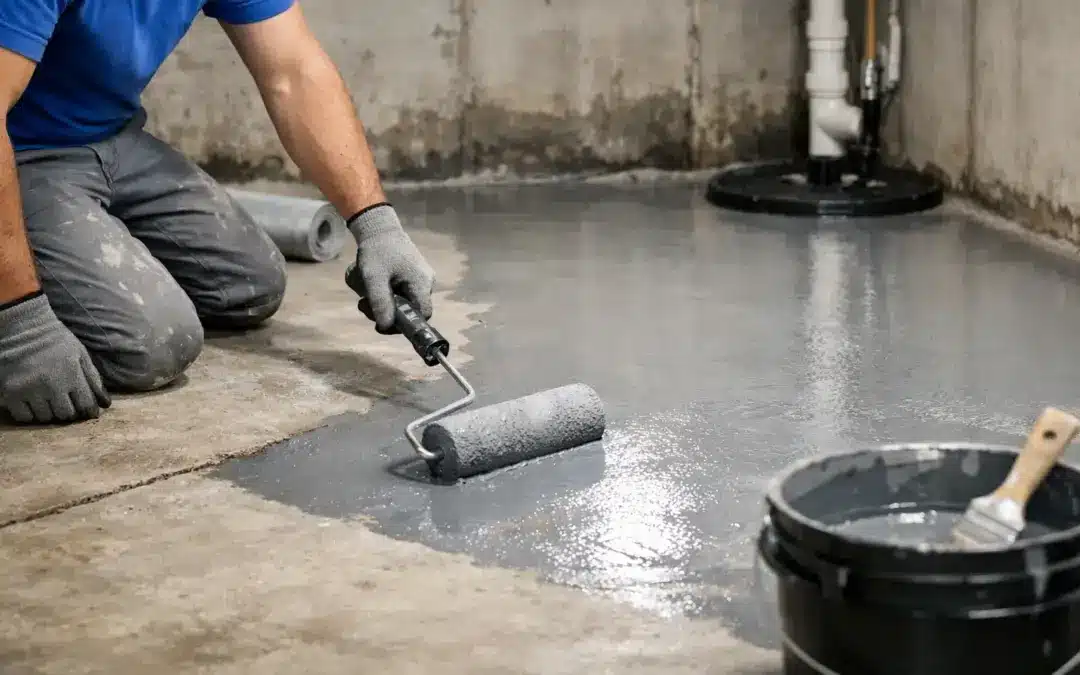
If your issue is minor moisture vapor moving through otherwise sound concrete, a penetrating sealer or masonry waterproof coating may help. These products are designed to reduce moisture transmission and protect the surface from dampness, staining, and mild deterioration.
Preparation matters more than the product label. The floor must be clean, bare, and structurally sound. Old paint, adhesive, efflorescence, and debris need to be removed so the sealer can bond properly. Cracks should also be evaluated before coating. Hairline shrinkage cracks may be manageable, but active cracks that widen, leak, or shift need repair first.
This method has limits. Surface coatings are not a cure for standing water, hydrostatic pressure, or foundation movement. If water is being forced up through the slab, the coating may blister, peel, or fail. That is why some basement floors look better for a few months and then return to the same problem.
When cracks and joints are the real problem
Many wet basement floors are not failing across the whole slab. They are leaking at specific weak points. The two most common are floor cracks and the cove joint.
Cracks can often be sealed, but the repair method depends on the crack behavior. A dormant crack may be filled and sealed. An active crack tied to settlement or pressure may need a more specialized repair approach. If the floor is uneven, heaving, or separating, that points to a bigger structural or drainage issue that should not be covered up.
The cove joint deserves special attention because homeowners often mistake it for a wall leak. This joint is where the basement wall meets the floor slab, and it is a common place for groundwater to appear when pressure builds outside the foundation. Caulking this seam rarely solves the problem for long. In many cases, the right fix is interior drainage along the perimeter that relieves pressure and directs water to a sump system.
How to waterproof basement floor areas with drainage
If water is entering from below or at the slab edge, drainage is usually more reliable than surface treatment. This is especially true in homes with recurring seepage after storms or snowmelt.
An interior drainage system works by intercepting water before it spreads across the floor. A channel is created along the basement perimeter, water is directed into a sump basin, and the sump pump discharges it away from the home. When designed correctly, this approach addresses pressure instead of trying to overpower it with coatings.
Not every basement needs a full perimeter system, though. That is where a science-driven inspection can save money. Some homes only need targeted drainage in one section. Others need a sump upgrade, a buried discharge correction, or a repair at a specific entry point. A permanent fix is often smaller and more economical than homeowners expect once the source is confirmed.
Do not ignore exterior conditions
Basement floor waterproofing often starts outside, even when the symptom is inside. If roof runoff is dumping near the foundation, or the yard slopes toward the house, the basement floor may keep getting wet no matter what coating or interior repair you apply.
Check that gutters are clear and downspouts carry water well away from the home. Make sure the soil next to the foundation slopes outward rather than inward. Look for low spots near window wells, steps, and porch connections. In older Philadelphia-area housing stock, years of settlement can change drainage patterns enough to create chronic basement moisture.
Exterior corrections are not always the whole answer, but they often reduce the water load significantly. That makes any interior system work better and last longer.
Humidity can make the floor seem worse than it is
A damp basement floor is not always a leak. In summer, humid air enters the basement and condenses on cool concrete. The floor feels wet, the room smells musty, and homeowners assume groundwater is coming through the slab.
That is why diagnosis matters. If the problem is condensation, the solution may involve dehumidification, air sealing, insulation adjustments, and better ventilation control rather than structural waterproofing. It is still a real moisture issue, because high humidity supports mold growth and damages finishes, but it should be treated accurately.
The best fix depends on what you want from the basement
A storage basement and a finished basement do not have the same tolerance for moisture. If you only want a cleaner, drier utility area, sealing and humidity control may be enough. If you plan to install flooring, drywall, or use the basement as living space, the standard should be much higher.
That is where targeted recommendations matter. Spending too little can leave hidden moisture under finished materials. Spending too much on a one-size-fits-all system can be just as frustrating. The right plan balances source control, long-term dryness, and cost.
For homeowners who have tried paint, patch products, or repeated cleanup with no lasting result, the smarter move is a professional inspection that identifies the exact path of water intrusion. Basement Waterproofing Scientists takes that diagnostic-first approach because it protects homeowners from unnecessary work and gets to a permanent repair faster.
If you are deciding how to waterproof basement floor surfaces, think less about products and more about proof. The floor will stay dry when the cause is identified correctly and the fix matches the problem. That is what turns a damp basement from a recurring expense into usable, dependable space.