

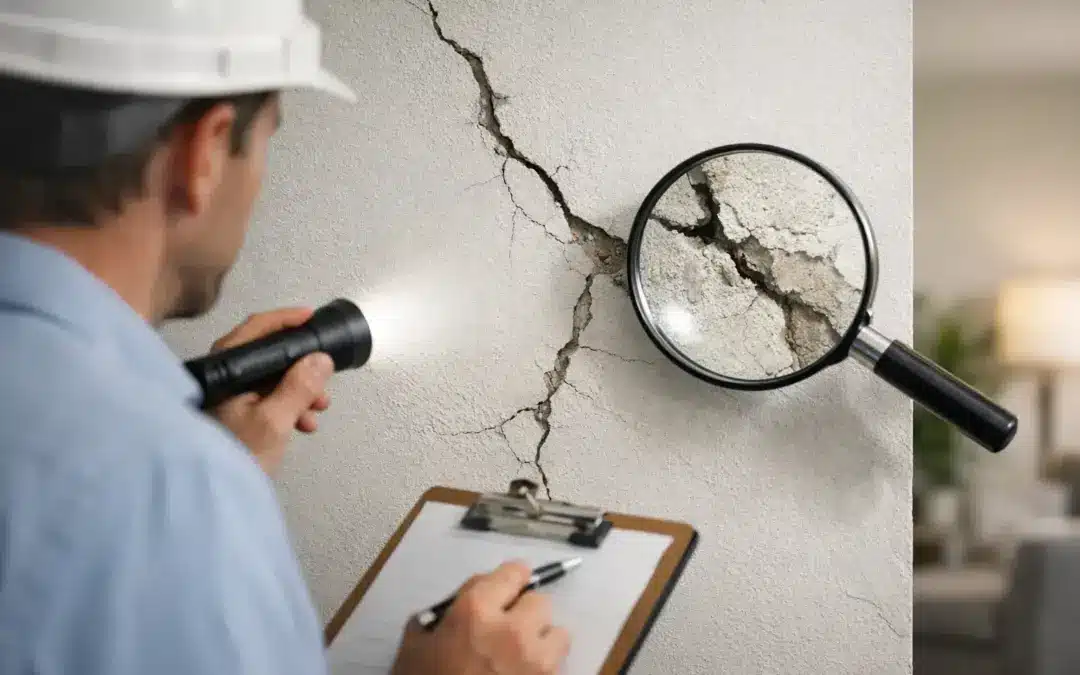
Wall cracks are not always structural, but appearance alone cannot establish which ones affect the building’s support. Material, location, movement, loading and surrounding conditions all matter. Record the crack and seek an appropriate assessment where the cause or significance is uncertain.
What does structural mean?
A structural concern involves the performance of a load-bearing component or related movement. A nonstructural concern may involve a finish or a repair objective such as water sealing. The American Concrete Institute’s crack guidance distinguishes structural and nonstructural purposes.
A crack can leak without proving structural failure. Conversely, a dry crack is not automatically harmless. Avoid classifying every vertical crack as safe or every horizontal or stair-step crack as one specific diagnosis.
Which observations are useful?
- Wall material and the crack’s location.
- Changes in length, width or alignment over time.
- Displacement, bowing, deterioration or damaged supports.
- Related changes in floors, openings or adjacent components.
- Water entry, previous repairs and alterations.
Date photographs and retain earlier reports. A single measurement is one observation, not a complete safety test.
When should you obtain prompt help?
Apparent instability, sudden significant movement or damaged load-bearing components warrants prompt professional attention. Avoid unsafe areas and contact emergency services for an immediate threat. Do not remove supports, excavate or install improvised reinforcement.
Ask an appropriately qualified professional whether engineering, monitoring or further investigation is needed. Monitoring should have a purpose and clear triggers for follow-up.
How should repair be selected?
Define whether the objective is cosmetic treatment, leak control, stabilization, strengthening or correction. A suitable sealant or injection does not automatically resolve movement. A drain does not automatically restore load-bearing capacity.
Use product-specific requirements and a design suited to the construction. Poured concrete, hollow block, brick and stone are not interchangeable substrates.
What should a proposal document?
Request findings, limitations, repair details, design responsibility and applicable approvals. Clarify access, utilities, inspections, restoration and monitoring. Read actual warranty terms rather than universal lifespan or permanent-safety promises.
See our crack repair planning guide and movement observations guide. Basement Waterproofing Scientists offers free inspections in southeastern PA, southern NJ and Delaware. Call 610-615-7111 or contact us to discuss the condition and any specialist needs.