

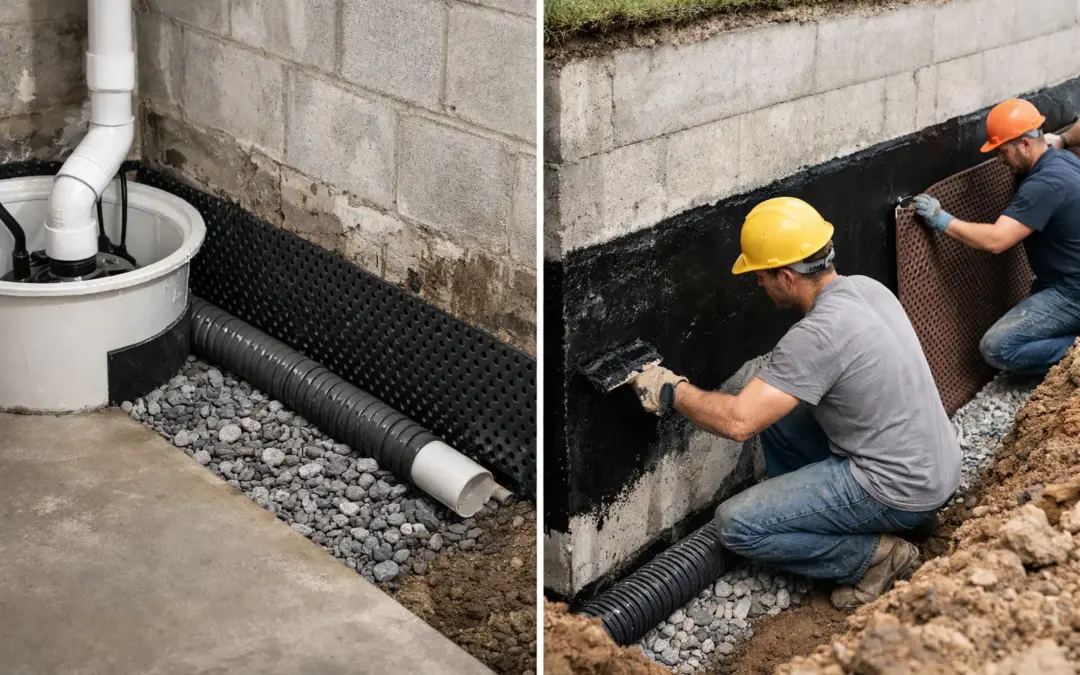
A wet basement rarely gives you a simple choice. Water may be entering through a wall crack, pushing up at the floor-wall joint, collecting against the foundation outside, or traveling through hidden pathways before it becomes visible. That is why the decision between interior drainage versus exterior sealing should start with diagnosis, not a sales pitch for one system.
For homes across Greater Philadelphia, Southeast Pennsylvania, and Southern New Jersey, the right fix depends on where water is coming from, how the foundation was built, soil conditions, access around the home, and whether the problem is occasional or recurring. Both approaches can be effective. Neither is automatically the best answer for every basement.
What Interior Drainage Does
Interior drainage manages water after it reaches the foundation. A contractor installs a drainage channel along the inside perimeter of the basement floor, typically directing collected water to a sump pit and pump. The pump then discharges the water safely away from the home.
This method is especially effective when groundwater pressure is building beneath the slab or against the foundation walls. In older homes, water often appears at the cove joint – the narrow seam where the basement wall meets the floor. That does not necessarily mean the wall itself has failed. It often means water has nowhere else to go once the soil around the home becomes saturated.
An interior system does not usually require excavating the yard, removing decks, disturbing landscaping, or digging beside utility lines. That makes it a practical option when exterior access is limited or when the source is widespread groundwater rather than one isolated crack.
When interior drainage is the practical choice
Interior drainage is commonly recommended when hydrostatic pressure is the main problem. Heavy rain may leave puddles along several walls, water may seep through the floor-wall joint, or the basement may feel damp during wet seasons even without a visible opening in the wall.
It can also be the more economical permanent solution when exterior excavation would require removing patios, porches, sidewalks, landscaping, or finished hardscaping. The goal is not to avoid exterior work at all costs. It is to avoid paying for disruptive excavation when managing the water at its natural collection point will solve the problem reliably.
A properly designed interior drainage system must include more than a trench and a pump. The drainage path, sump basin, pump capacity, discharge location, backup protection, and wall condition all matter. If the pump sends water too close to the foundation, the system can create a cycle where the same water returns to the basement area.
What Exterior Sealing Does
Exterior sealing addresses water at the outside face of the foundation. This generally involves excavating to the footing, cleaning the wall, repairing cracks or defects, applying a waterproof membrane, and installing or correcting exterior drainage where needed. The soil is then restored with proper grading away from the house.
This approach is intended to stop groundwater and surface water from reaching the foundation wall in the first place. It is often the best fit for a specific, accessible exterior defect, such as a vertical crack that leaks in one location or a deteriorated section of foundation coating.
Exterior work can be highly effective, but it is more invasive. Excavation near a home requires careful planning around utility lines, landscaping, retaining walls, additions, driveways, and neighboring properties. It may also expose conditions that were not visible from inside, including damaged drain tile, crumbling mortar, or foundation wall deterioration.
When exterior sealing makes sense
Exterior sealing is often worth considering when the leak is localized and the outside wall can be reached safely. For example, if leak detection confirms that water enters through one crack after wind-driven rain, a targeted exterior repair may be more sensible than installing a full interior perimeter drainage system.
It may also be necessary when the foundation wall itself is structurally compromised or when water is entering through an exterior penetration, such as a poorly sealed utility opening. In these cases, simply collecting water indoors does not correct the damaged exterior condition.
However, exterior membrane work alone is not always enough. If roof runoff, poor grading, clogged gutters, or a failed footing drain keep sending water toward the foundation, the membrane is being asked to handle a larger problem. Surface water should be controlled before it reaches the wall whenever possible.
Interior Drainage Versus Exterior Sealing: The Real Trade-Offs
The biggest difference is not that one system is “inside” and the other is “outside.” It is the strategy behind each one. Interior drainage relieves and controls water that reaches the foundation. Exterior sealing blocks water from reaching the wall and may restore damaged exterior components.
Interior drainage is usually less disruptive to the property. Installation is performed from the basement, and it can be a strong long-term answer for recurring groundwater pressure. The trade-off is that it does not repair an exterior crack, failed grading, or damaged foundation coating by itself.
Exterior sealing can directly address a defined exterior leak path. The trade-off is cost, excavation, site access, and the possibility that a localized wall repair will not solve separate groundwater issues elsewhere around the foundation.
Neither solution should be sold as a universal cure. A homeowner with one leaking wall crack may not need a complete drainage system. A homeowner with water appearing around the entire basement perimeter may not benefit from excavating only one wall. The water pattern matters.
Signs That Help Identify the Right System
The location and timing of moisture are useful clues, although they are not a substitute for a professional inspection. Water that appears after every major storm near one wall or window well can point to an exterior drainage, grading, or crack issue. Water that rises at the floor edge during long wet periods often suggests hydrostatic pressure and may favor interior drainage.
White mineral deposits on masonry walls, peeling paint, rusted columns, musty odors, and mold growth indicate moisture exposure, but they do not identify the exact entry point. Water can travel behind finished walls or through block cores before it becomes visible several feet away from the actual problem.
That is why a visual estimate alone can be misleading. A science-driven inspection should look at the exterior grade, gutters and downspouts, crack patterns, sump operation, wall movement, drainage conditions, and the way water behaves around the property. When appropriate, advanced leak detection scanning can help narrow down the actual moisture path before recommending major work.
Do Not Ignore Foundation and Mold Concerns
Waterproofing and structural repair sometimes overlap. A crack that is simply allowing water through may need targeted sealing. A crack that is widening, stair-stepping through block, or accompanied by bowing walls may require foundation repair in addition to moisture control.
Likewise, a dry-looking basement can still have a mold concern if moisture has been trapped behind finished walls, carpeting, or insulation. Waterproofing stops the source, but contaminated materials and affected surfaces may need separate remediation. Treating odor with paint, dehumidifiers, or temporary sealants without correcting the moisture source usually delays the larger repair.
Choose a Diagnosis, Not a Package
The most economical permanent fix is the one that matches the actual cause of the leak. That may be a targeted exterior crack repair, an interior drainage system, improved surface drainage, sump pump replacement, or a combination of solutions. Homeowners should be cautious when a contractor recommends the same full system before examining the foundation, water pattern, and site conditions.
At Basement Waterproofing Scientists, the focus is on identifying where moisture is entering and prescribing work that fits the problem, not selling unnecessary excavation or oversized systems. A clear explanation of the findings, the proposed repair, and the expected outcome should come before any decision.
A basement should not remain a place you avoid after every storm. Start with a careful inspection, ask what evidence supports the recommendation, and choose the repair that gives your home the best path to staying dry for the long term.