

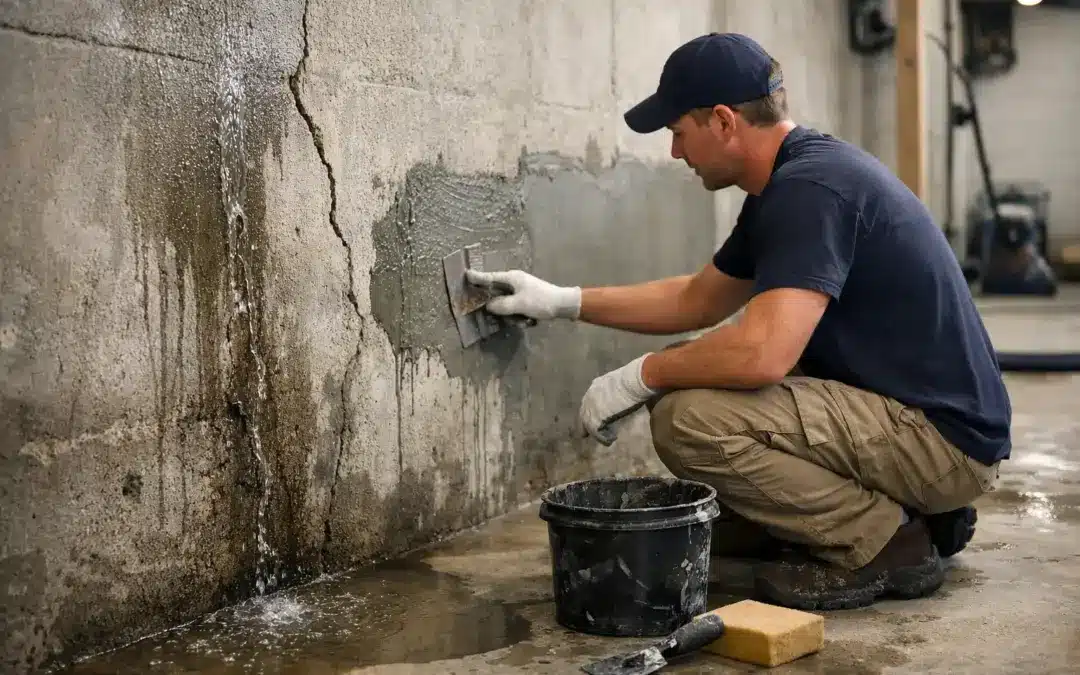
A wet line running down a basement wall after every hard rain is not a cosmetic problem. It is evidence that water has found a path through, around, or beneath your foundation. Effective leaking basement wall repair begins with identifying that path, not with applying a quick coating over the visible stain.
For homeowners in Greater Philadelphia, Southeast Pennsylvania, and Southern New Jersey, this distinction matters. Our older housing stock, clay-heavy soils, seasonal storms, and freeze-thaw cycles can all put pressure on foundation walls. The repair that permanently solves a narrow crack may do very little for water entering at the footing, through a failed window well, or from overflowing gutters.
What a Leaking Basement Wall Is Telling You
Water follows the path of least resistance. When the soil around a foundation becomes saturated, hydrostatic pressure builds against the exterior wall. Even concrete and masonry walls that look solid can allow water through small cracks, porous areas, mortar joints, utility penetrations, and joints where the wall meets the floor.
The visible leak is not always the source. Water may travel through block cores, along framing, or behind finished walls before appearing several feet away. That is why a damp patch, peeling paint, white mineral deposits, or a musty odor should be treated as diagnostic clues rather than a complete diagnosis.
A wall that leaks only during prolonged rain points to a different problem than a wall that stays damp year-round. A leak that appears after snowmelt may be tied to exterior drainage. Water concentrated around one crack may indicate a localized opening, while moisture along an entire wall can suggest broader drainage or groundwater pressure concerns.
Start With the Source, Not the Surface
The most economical repair is the one that addresses the actual water entry point. Before choosing a solution, a qualified inspection should consider the wall material, crack pattern, grading, roof drainage, downspout discharge, nearby window wells, plumbing lines, and the timing of the leak.
Scientific leak detection scanning can help distinguish active water paths from old staining. This is especially valuable in finished basements, where removing drywall or paneling without evidence can turn a straightforward repair into an unnecessary renovation expense. The goal is to recommend only the work the home needs – no generic package and no guesswork.
Homeowners can also gather useful information before an inspection. Note whether the leak happens during rain, after rain, or only when a particular fixture is used. Take photos of the area while it is actively wet, and look outside for pooling water, short downspouts, clogged gutters, or soil that slopes toward the house. These details help connect conditions outside the foundation with symptoms inside it.
Leaking Basement Wall Repair Options
The correct repair depends on why the wall is leaking. Several solutions may be appropriate, but they are not interchangeable.
Crack injection for isolated wall cracks
A narrow, nonstructural crack that allows rainwater into a poured concrete wall can often be repaired with a professional polyurethane or epoxy injection. Polyurethane is commonly used where an active water leak needs to be stopped because it expands into the crack and can remain flexible. Epoxy is often selected when restoring structural continuity is part of the repair.
Injection is targeted, minimally disruptive, and often cost-effective. It is not, however, a cure for ongoing pressure affecting an entire foundation wall. If the soil is constantly saturated or water is entering at multiple locations, treating one crack alone may only move the symptom.
Interior drainage for water at the wall-floor joint
If water enters where the basement wall meets the floor, or if groundwater pressure is persistent, an interior drainage system may be the dependable answer. This approach collects water beneath or alongside the floor perimeter and directs it to a sump system for discharge away from the house.
Interior drainage manages water pressure rather than asking the foundation wall to hold back every gallon of groundwater. It can be an excellent solution for finished or difficult-to-access exteriors. The trade-off is that it involves opening a section of the basement floor, so the installation should be designed carefully and restored professionally.
Exterior drainage and foundation waterproofing
When an exterior defect is accessible and clearly responsible, exterior waterproofing may be warranted. This can involve excavating to the foundation, repairing cracks or deteriorated masonry, applying a waterproof membrane, and improving drainage at the footing.
Exterior work addresses water before it reaches the wall, which is a major advantage. But excavation is more disruptive and may not be necessary for every leak. Landscaping, decks, additions, utilities, and neighboring structures can affect feasibility and cost. A diagnostic inspection should establish whether exterior work provides a meaningful benefit over a targeted interior solution.
Masonry, block wall, and joint repair
Block foundations often leak through mortar joints, deteriorated block faces, or the hollow cores of the masonry units. Stone foundations can have similar issues where mortar has aged or shifted. These walls may require repointing, joint sealing, structural stabilization, drainage correction, or a combination of repairs.
A painted waterproof coating may improve appearance, but it should not be relied on as the primary solution for an actively leaking masonry wall under pressure. Coatings can blister and peel when moisture remains trapped behind them. The water management issue must be corrected first.
When a Leak May Also Be a Foundation Concern
Not every crack means the foundation is failing. Small vertical cracks are common in concrete as it cures and settles. Still, some signs call for closer evaluation: horizontal cracking, stair-step cracks in block or brick, bowing walls, widening gaps, displaced masonry, or cracks accompanied by sticking doors and sloping floors.
Water is often part of the story. Saturated soil can increase lateral pressure on basement walls, and poor drainage can make an existing structural issue worse. In these cases, leak repair and foundation repair should be considered together. Sealing a crack without addressing wall movement is not a permanent solution.
Avoid Repairs That Hide the Problem
A tube of caulk, hydraulic cement, or waterproof paint can be useful for minor maintenance or temporary damage control. They are rarely a reliable answer to active water intrusion. If you use a temporary patch, treat it as a way to limit immediate mess while arranging a proper assessment, not proof that the problem is fixed.
Be cautious with recommendations that jump straight to a full basement system without investigating the leak pattern. A complete system can be appropriate, but it should be supported by evidence. You deserve to know where water is entering, why the recommended repair addresses that condition, and what the scope does not include.
Also avoid delaying because the leak seems small. Repeated dampness can damage stored belongings, flooring, framing, insulation, and electrical components. It can also create conditions that support mold growth, particularly behind finished walls where moisture is harder to see.
What to Expect From a Professional Inspection
A useful basement inspection should leave you with more than a price. You should understand the probable water path, the condition of the wall, the repair options, and why one approach makes more sense for your home than another.
At Basement Waterproofing Scientists, the focus is on finding the cause through targeted evaluation and recommending the most economical permanent repair. For a homeowner, that means a localized crack repair when a localized repair is enough, and a broader drainage or structural solution only when the evidence supports it. Ask about warranty coverage as well, particularly for work intended to stop recurring water intrusion.
Protect the Area While You Plan the Repair
Move boxes, furniture, and electronics away from the affected wall. If standing water is present, keep electrical cords and outlets in mind and do not enter a flooded area if electrical safety is uncertain. Run a dehumidifier once the leak is controlled, but remember that dehumidification removes moisture from the air – it does not stop water from entering the foundation.
Outside, keep gutters clear and extend downspouts so roof runoff discharges well away from the house. Maintain positive grading where practical, meaning the soil slopes away from the foundation rather than directing water toward it. These steps support a repair, but they do not replace one when there is an active crack, drainage failure, or structural defect.
A basement wall leak is frustrating, but it is also actionable. The next rainfall does not have to be another test of buckets and towels. With a clear diagnosis and a repair matched to the true source, your basement can return to being dry, usable space rather than a constant concern.