

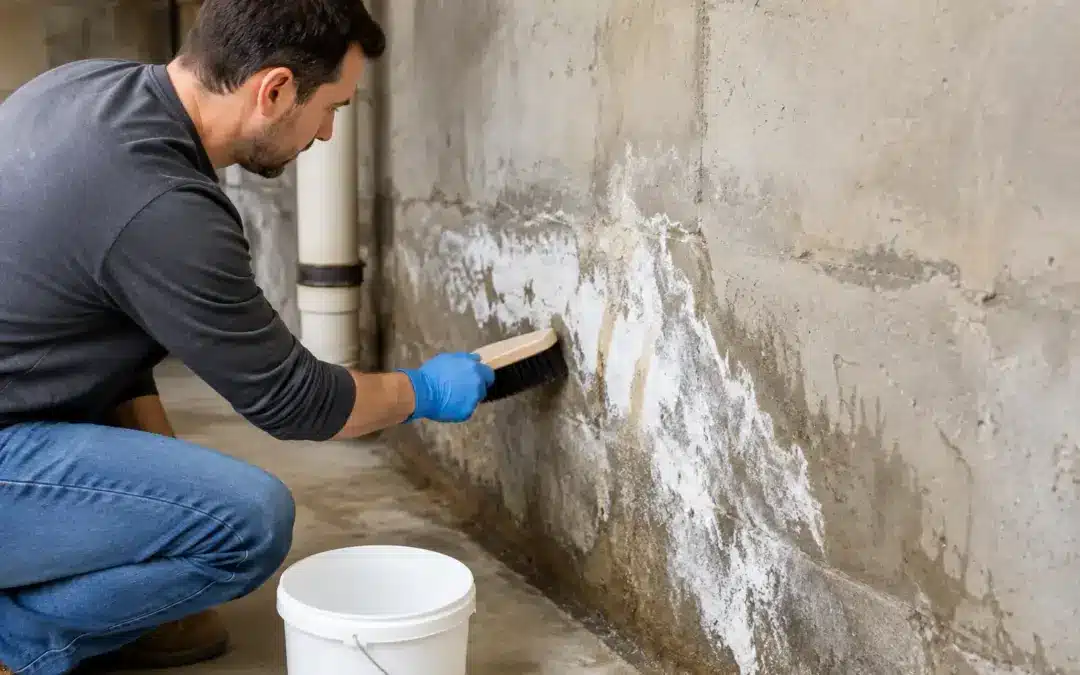
To address basement efflorescence, investigate the moisture and salts producing the deposits before choosing cleaning or coating. Removing white residue changes the appearance but does not by itself correct water entry. Recurring deposits deserve assessment, while an old deposit alone does not prove current leakage or structural failure.
What is efflorescence?
Efflorescence is salt deposited on masonry as moisture carries dissolved material toward a surface and evaporates. The Concrete Masonry and Hardscapes Association’s guidance discusses moisture and salt sources, including construction moisture and recurring water migration.
Not every white mark is the same condition, and visual appearance alone may be inconclusive. Efflorescence is not mold, but mold is not reliably distinguished by assuming it must be dark. If the material is uncertain, obtain an appropriate assessment before disturbing it.
How should you investigate the source?
Photograph the location and note whether deposits return or expand. Record wet areas and timing relative to rain or plumbing use. Check accessible roof runoff paths, exterior low spots, openings and previous repairs.
A deposit beneath a window is a clue, not proof that the window is the source. Water can travel within an assembly. Identify wall material and any deteriorated mortar or movement, and ask what remains concealed or uncertain.
Which repairs may be relevant?
- Correcting a documented runoff route toward the foundation.
- Repairing a suitable localized defect with compatible materials.
- Providing collection and discharge for recurring seepage where justified.
- Addressing plumbing leaks or other separate moisture sources.
- Assessing structural displacement or deterioration before concealment.
A dehumidifier can address airborne moisture but does not stop every water path through masonry. A drainage system should not be recommended solely because salts are visible. Match the scope to the investigation.
How should existing deposits be cleaned?
Use a method compatible with the masonry and condition. CMHA notes that water used for cleaning can introduce additional moisture, especially under pressure. Historic or deteriorated masonry needs particular care; the National Park Service’s masonry cleaning guidance discusses treatment selection and potential damage.
Do not apply a universal acid, wire-brushing or pressure-washing recipe. Follow appropriate product and safety instructions, test suitability and seek qualified help where needed. Review coating compatibility only after the moisture and surface conditions are understood.
When should you request an inspection?
Arrange help for returning deposits with active wetting, damaged finishes, deteriorating masonry or changing cracks. Basement Waterproofing Scientists offers free inspections in southeastern PA, southern NJ and Delaware. Call 610-615-7111 or contact us to discuss the observed moisture pattern and our waterproofing services.