

Why Finding the Best Product for Sealing Foundation Cracks Protects Your Home’s Value
The best product for sealing foundation cracks depends on the crack type and severity:
- Epoxy Injection – Best for structural repairs and wide cracks needing high bonding strength
- Polyurethane Foam Injection – Best for active leaks, wet conditions, and flexible waterproofing
- Hydraulic Cement – Best for quick, temporary patches on minor surface cracks
- DIY Injection Kits – Best for hairline, non-structural cracks under 1/4 inch wide
Foundation cracks are more than cosmetic blemishes. They’re warning signs that your home’s structural integrity may be at risk. With moisture present in 60 percent of U.S. houses and water intrusion causing 70 percent of construction litigation, choosing the right crack sealant isn’t just about stopping leaks—it’s about protecting your investment and your family’s health from mold and structural damage.
The challenge? Walk into any home improvement store and you’ll face dozens of products claiming to seal foundation cracks permanently. Some promise overnight results. Others require specialized injection equipment. The stakes are high: choose wrong, and you might waste money on a temporary fix that fails within months, leaving you to deal with water damage, mold growth, and potentially higher repair costs down the road.
Not all foundation cracks are created equal. A hairline vertical crack from normal concrete curing requires a completely different approach than a horizontal crack caused by hydrostatic pressure. The wrong product won’t just fail—it can mask serious structural problems that continue to worsen beneath the surface.
I’m Darin Garvey, and over three decades of basement waterproofing work has taught me exactly which products deliver lasting results for different crack scenarios. Understanding the best product for sealing foundation cracks for your specific situation is the difference between a quick fix that fails and a repair that protects your home for years to come.
Learn more about best product for sealing foundation cracks:
Understanding Foundation Cracks: A Homeowner’s Guide
When we talk about foundation cracks, we’re not just looking at superficial damage. These fissures can be tell-tale signs of deeper issues affecting your home’s stability. Understanding the different types of cracks, their severity, and what causes them is the first step toward finding the best product for sealing foundation cracks and ensuring a lasting repair.
Our experience across Pennsylvania, New Jersey, and Delaware shows us that many factors contribute to foundation cracks, from the natural settling of your home to significant soil and water pressure. The American Society of Home Inspectors reports that moisture is present in 60 percent of U.S. houses, with 38 percent running the risk of basement mold. Furthermore, water intrusion causes 70 percent of construction litigation. These statistics highlight why addressing foundation cracks promptly and correctly is so crucial for preventing water intrusion and protecting your home’s structural integrity.
Vertical and Hairline Cracks
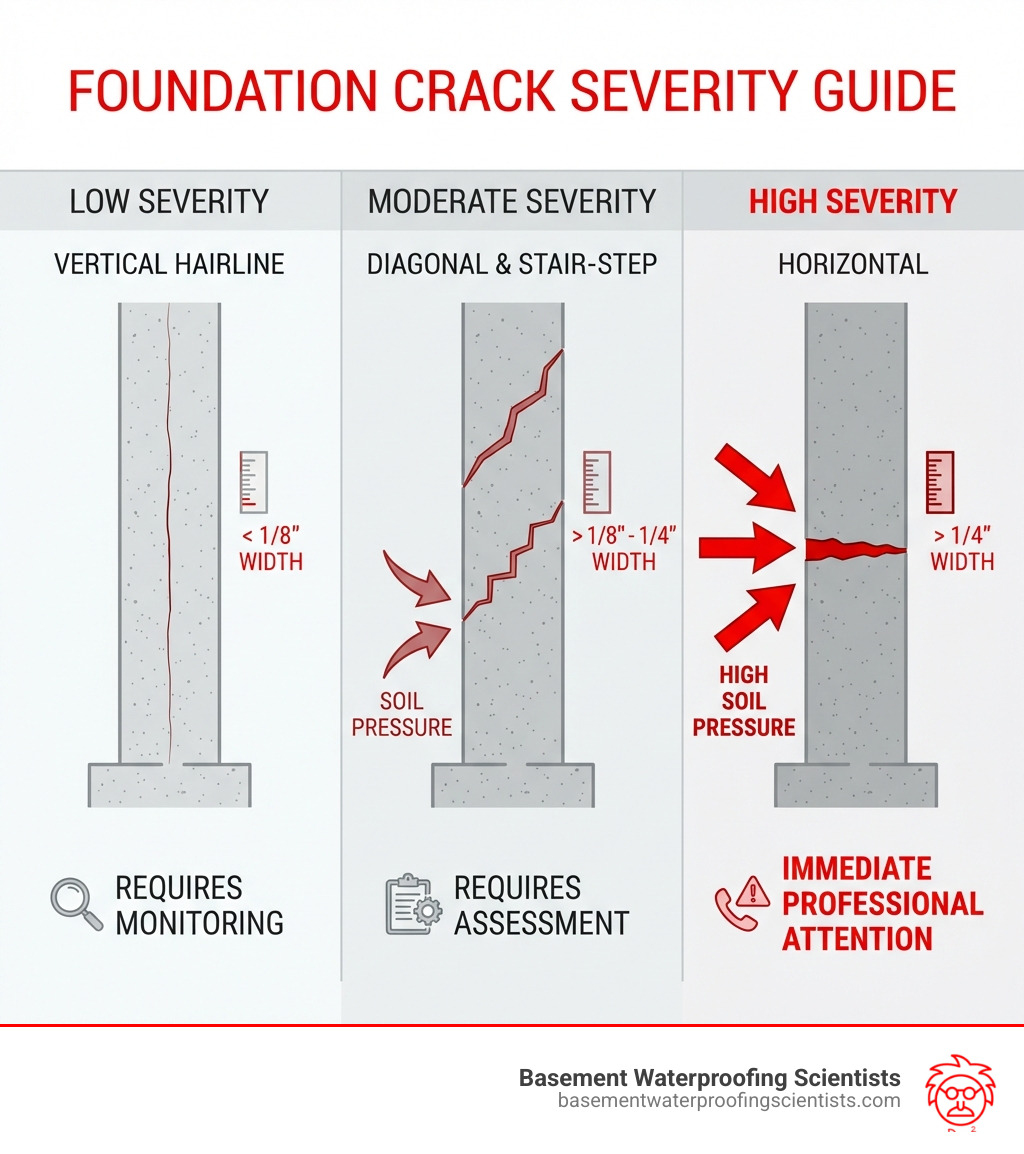
Let’s start with the least alarming, though still important, types of cracks. Vertical cracks run straight up and down, while hairline cracks are very thin, often less than 1/16th of an inch wide.
Concrete curing and shrinkage are common culprits for these types of cracks. As concrete dries and cures, it naturally shrinks, leading to small, superficial fissures. These are often considered minimal concern from a structural standpoint. Many hairline cracks are purely cosmetic.
However, even these seemingly innocuous cracks warrant monitoring. While they may not immediately threaten your home’s structure, they can create pathways for water seepage potential. If you notice a vertical or hairline crack that starts to widen, lengthen, or show signs of moisture, it’s time to pay closer attention. Even small cracks can allow radon gas, moisture, and insects into your basement, compromising indoor air quality and comfort.
Diagonal and Stair-Step Cracks
Moving up the severity ladder, we encounter diagonal and stair-step cracks. These indicate a more significant underlying issue than simple shrinkage.
Diagonal cracks run at an angle, typically around 30 to 75 degrees from vertical. Stair-step cracks appear in masonry foundations (like concrete block walls) and follow the mortar joints, resembling a flight of stairs. Both types often point to differential settlement. This occurs when different parts of your home’s foundation settle at varying rates or to different depths.
Soil issues are frequently behind differential settlement. Factors like inconsistent soil compaction during construction, changes in soil moisture content (e.g., expansive clay soils expanding when wet), or even growing tree roots can cause uneven pressure on the foundation. These cracks are of moderate severity and should not be ignored.
When we see diagonal or stair-step cracks, our professional assessment is highly recommended. These cracks can evolve into more serious structural problems if the underlying cause isn’t addressed. They need a solution that not only seals the crack but also considers the movement and pressure causing it.
Horizontal Cracks
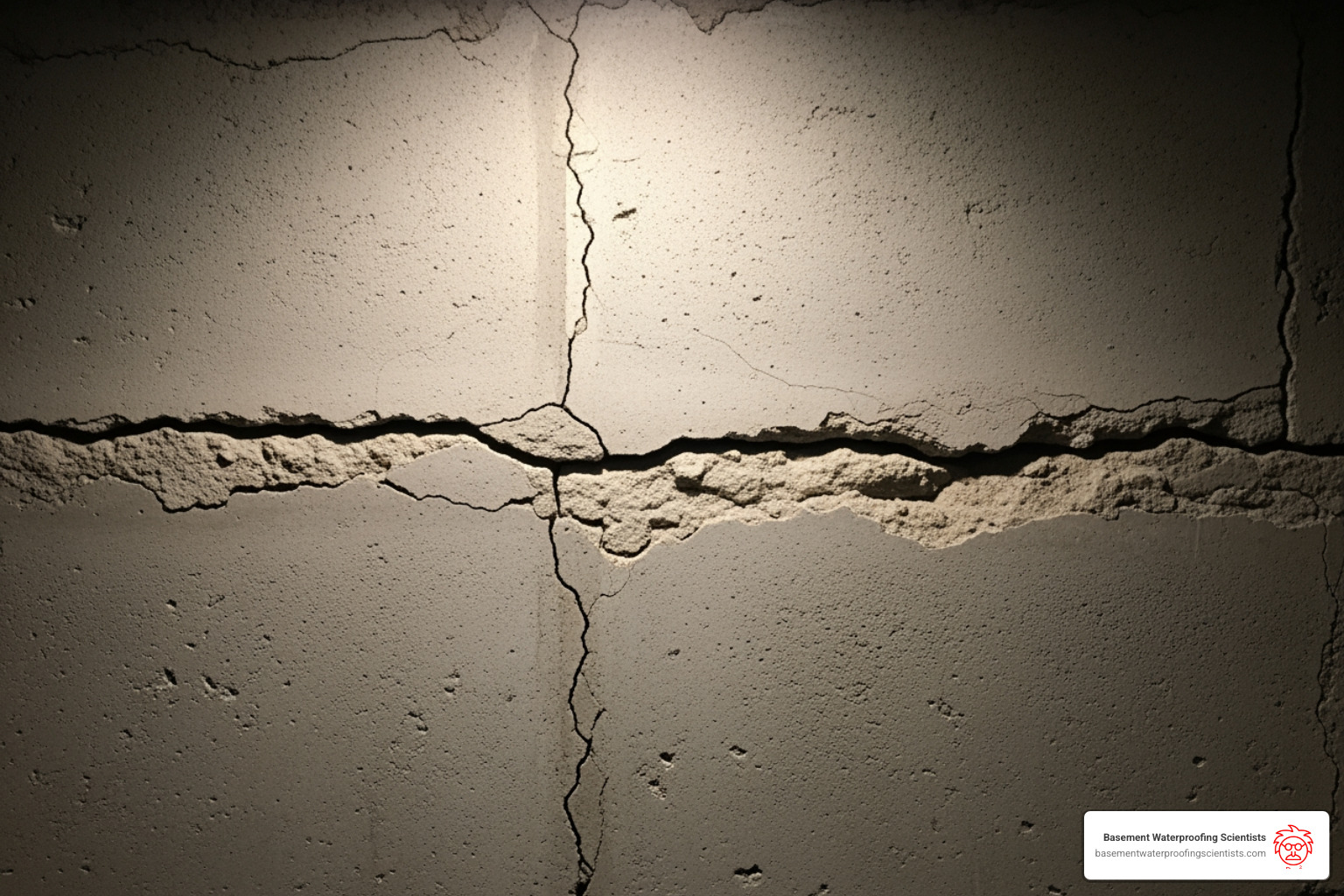
Now, for the red flag of foundation cracks: horizontal cracks. These cracks run parallel to the ground and are almost always a sign of a serious structural issue that demands immediate attention.
The primary cause of horizontal cracks is hydrostatic pressure. This occurs when the soil surrounding your foundation becomes saturated with water, often due to poor drainage, heavy rainfall, or a high water table. The waterlogged soil expands and exerts immense lateral force against your basement walls. Over time, this pressure can cause the wall to bow inward, crack horizontally, and eventually fail.
Bowing walls are a clear indicator that hydrostatic pressure is at play. If you observe any horizontal cracks, especially those accompanied by an inward curve of the wall, it’s a critical situation. This is not a DIY job. It requires immediate professional attention from a foundation repair specialist like us. Ignoring horizontal cracks can lead to catastrophic structural failure, putting your home and family at severe risk.
The Best Products for Sealing Foundation Cracks: A Material Breakdown
Once we understand the type and severity of a crack, we can then determine the best product for sealing foundation cracks. Choosing the right material is paramount for an effective and lasting repair. There’s a wide array of sealant types available, ranging from DIY to professional grade, each with specific applications for waterproofing or structural repair.
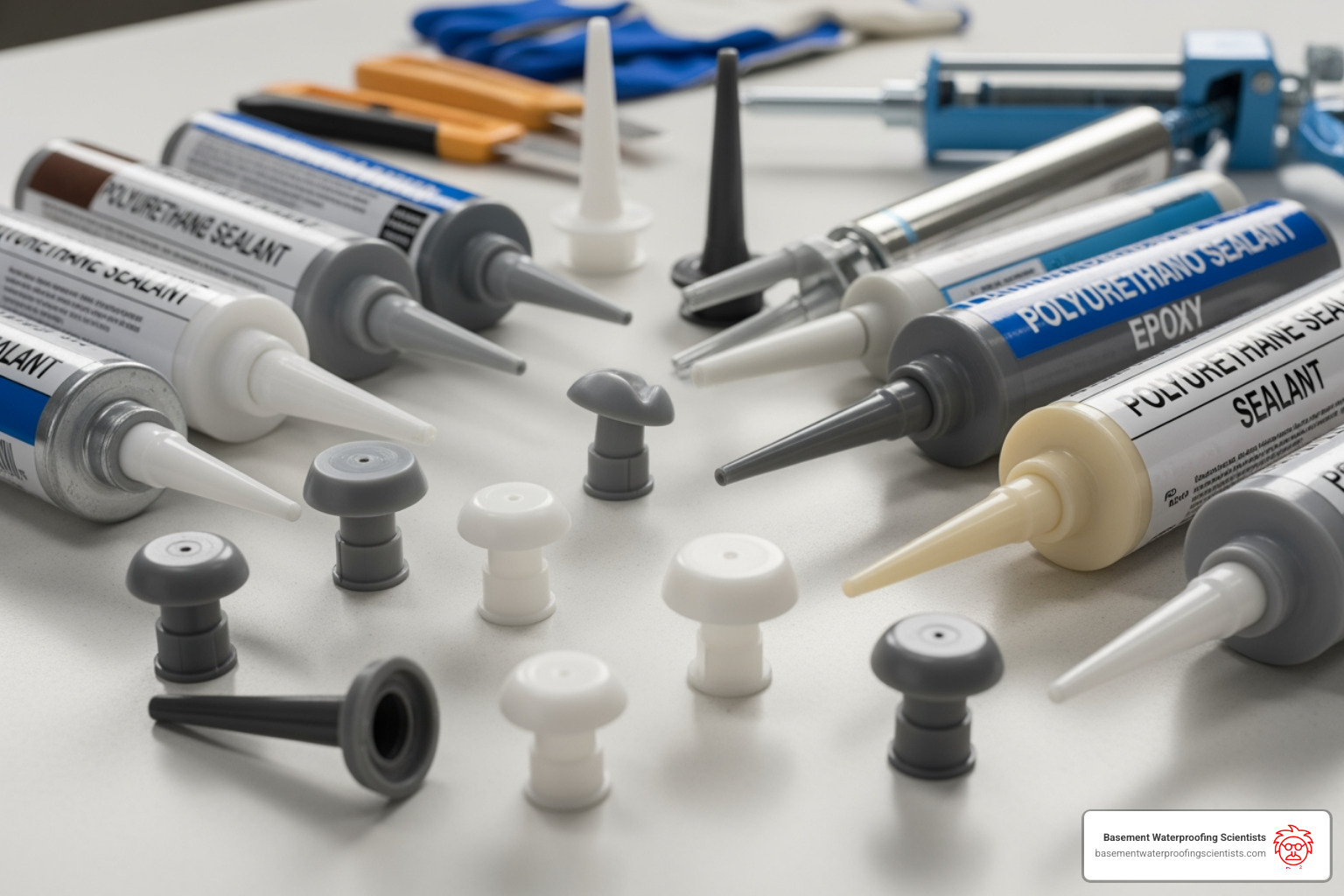
Let’s break down the primary materials we often use or encounter in foundation crack repair.
Epoxy Injection
Epoxy injection is a powerhouse in foundation crack repair, particularly when structural integrity is a concern.
Pros and Cons:
- Pros:
- Structural bonding: Epoxy is renowned for its exceptional bonding strength. When injected, it penetrates deep into the concrete and bonds the crack back together, essentially restoring the concrete’s original strength. It provides a durable, long-lasting, and watertight seal.
- High strength: It creates a rigid, load-bearing repair, making it ideal for cracks in load-bearing walls or areas under heavy stress.
- Restores concrete integrity: Unlike surface patches, epoxy injection truly repairs the concrete itself.
- Suitable for wider cracks: It’s often the preferred choice for cracks wider than 1/8 inch, and some formulations can handle cracks over an inch wide.
- Cons:
- Dry conditions: Epoxy works best on dry substrates. If the crack is actively leaking water, it will need to be stopped first.
- Slower cure time: Compared to polyurethane, epoxy generally takes longer to cure, sometimes several hours or even days to reach full strength.
- Rigid seal: While great for structural repairs, its rigidity means it doesn’t accommodate future foundation movement well. If the foundation continues to shift, the epoxy itself might crack.
- Higher cost: Due to its specialized application and superior durability, epoxy generally comes with higher material and labor costs.
We often recommend epoxy injection when dealing with structural cracks that threaten the stability of your foundation. It’s truly a long-term solution for restoring the strength of your concrete.
Polyurethane Foam Injection
Polyurethane foam injection is another highly effective method, particularly favored for its flexibility and waterproofing capabilities.
Pros and Cons:
- Pros:
- Flexible seal: Polyurethane creates a flexible, watertight seal that can accommodate minor foundation movement without re-cracking. This makes it suitable for areas where slight shifting might occur.
- Expands to fill voids: The foam reacts with moisture and expands up to 35 times its original volume, ensuring it fills the entire depth and length of the crack, even irregular pathways. This is crucial for stopping leaks.
- Active leaks/Wet conditions: Polyurethane works exceptionally well in wet and actively leaking cracks. Its reaction with water is what causes it to expand and cure, making it an excellent choice for stopping water intrusion.
- Fast cure time: Polyurethane cures quickly, often drying within minutes, which is a significant advantage when dealing with active leaks.
- Waterproofing focus: While it provides a strong seal, its primary benefit is waterproofing and sealing against water, vapor, insects, and even radon gas.
- Cons:
- Not primarily for structural repair: While it seals cracks effectively, polyurethane does not typically restore the structural integrity of the concrete in the same way epoxy does. It’s more about sealing and waterproofing than re-bonding.
- Less bonding strength: It has less bonding strength than epoxy, making it less suitable for cracks that require significant structural reinforcement.
- Temporary surface seal: If the crack is very wide, the initial surface seal might be temporary.
Polyurethane injection is a fantastic choice for hairline or non-structural cracks where foundations may shift, and especially for any crack that is actively leaking water. Its ability to expand and cure in wet conditions makes it invaluable for basement waterproofing.
Hydraulic Cement
Hydraulic cement is a familiar name for many homeowners looking for a quick fix.
Pros and Cons:
- Pros:
- Quick patch: It’s known for its rapid setting time. When mixed with water, it hardens extremely quickly, often within minutes.
- DIY-friendly: Hydraulic cement is relatively easy to use and can be applied by homeowners for minor issues.
- Stops active leaks temporarily: It can be very effective at temporarily stopping active water leaks in cracks, as it sets even underwater.
- Good adhesion: It provides good adhesion to concrete surfaces.
- Affordable: Generally a very cost-effective material.
- Cons:
- Low flexibility: Once cured, hydraulic cement is rigid. Like epoxy, it does not accommodate foundation movement, making it prone to re-cracking if the foundation shifts.
- Not a deep-penetrating solution: Due to its high viscosity, hydraulic cement primarily acts as a surface patch. It doesn’t penetrate deep into the crack to seal the entire fissure, meaning water can still seep behind it.
- Temporary fix: Because of its rigidity and lack of deep penetration, it often acts as a temporary patch that may flake off or re-crack over time, especially in active leaks.
- Not for structural repair: It does not restore the structural integrity of the concrete.
- Limited use for deep cracks: It can’t reach far enough into most cracks to offer a proper, long-term seal.
While quick setting cement can be useful for minor, non-structural surface repairs or for temporarily stopping active leaks, we generally view hydraulic cement as a short-term solution for foundation cracks, particularly in areas prone to movement or deep water intrusion. For lasting waterproofing and structural repairs, we turn to more advanced injection methods.
Injection Showdown: Epoxy vs. Polyurethane for Lasting Repairs
When it comes to high-performance solutions for foundation cracks, epoxy and polyurethane injections are the leading contenders. Both are highly effective, but their unique properties make them suitable for different scenarios. Understanding their distinctions is key to choosing the best product for sealing foundation cracks in your home.
| Feature | Epoxy Injection | Polyurethane Foam Injection |
|---|---|---|
| Bonding Strength | Superior, restores structural integrity | Good, primarily for sealing/waterproofing |
| Flexibility | Rigid, does not accommodate movement | Flexible, accommodates minor foundation movement |
| Best Use Case | Structural repairs, re-bonding concrete | Waterproofing, sealing active leaks |
| Crack Size Suitability | Wider structural cracks (over 1/8″, up to 1″+) | Hairline to wider non-structural cracks (up to 1/2″) |
| Cure Time | Slower (hours to days) | Fast (minutes) |
| Moisture Tolerance | Best on dry substrates | Reacts with moisture, effective in wet/leaking cracks |
| Long-term Effectiveness | Excellent for structural stability in stable conditions | Excellent for waterproofing and flexible sealing |
This table highlights the crucial differences that guide our choice for the best product for sealing foundation cracks. We consider crack type suitability, potential for foundation movement, and desired long-term effectiveness.
When to Choose Epoxy Injection
Epoxy injection is our go-to solution when structural integrity is the primary concern.
- Structural cracks: If the crack is impacting the load-bearing capacity of your foundation, epoxy is the answer. It literally welds the concrete back together.
- Load-bearing walls: For cracks in foundation walls that support the weight of your home, epoxy provides the necessary strength and rigidity.
- Wide cracks: Generally, for cracks wider than 1/8 inch, and especially those approaching or exceeding an inch, epoxy’s ability to fill and bond is superior.
- Restoring strength: If the goal is to fully restore the concrete’s original strength and prevent further structural degradation, epoxy is best.
- When a rigid bond is needed: In stable areas where foundation movement is not anticipated, the rigid, permanent bond of epoxy is highly advantageous. It creates a repair that is often stronger than the surrounding concrete.
Epoxy works best on dry concrete. If there’s active water intrusion, we might need to address that first before applying epoxy for structural reinforcement.
When to Choose Polyurethane Injection
Polyurethane foam injection shines where flexibility and waterproofing are paramount, particularly when dealing with active water problems.
- Non-structural cracks: For hairline or other cracks that are not threatening the structural integrity but are allowing water entry, polyurethane is ideal.
- Active water leaks: This is where polyurethane truly excels. Its unique ability to react with water and expand rapidly makes it incredibly effective at stopping active leaks almost instantly. We’ve seen it work wonders in damp basements across Pennsylvania, New Jersey, and Delaware.
- Hairline cracks: The low viscosity of some polyurethane formulations allows them to penetrate even very fine hairline cracks, sealing them completely.
- Areas with potential for minor foundation movement: Because polyurethane remains flexible after curing, it can accommodate slight shifts in the foundation without re-cracking. This is crucial in our region where soil conditions can sometimes lead to minor foundation movement.
Polyurethane is also more affordable upfront and quicker to apply, making it a highly efficient solution for many waterproofing scenarios.
Can Epoxy and Polyurethane Be Used Together?
In some complex scenarios, the answer is a resounding yes! While rare, combining these two powerful materials can provide a comprehensive solution for challenging foundation repairs.
- Complex repairs: Imagine a crack that is both actively leaking significant amounts of water and also poses a structural concern due to its width or location.
- Two-step process: In such cases, we might employ a two-step process.
- Stopping active leaks first: We would typically start with polyurethane injection. Its rapid expansion and moisture-reactive properties make it excellent for immediately stopping the flow of water and filling large voids. This creates a dry environment within the crack.
- Providing structural reinforcement second: Once the crack is dry and sealed against water intrusion by the polyurethane, we can then inject epoxy. The epoxy can then bond the concrete structurally, restoring its strength without being hindered by the presence of water.
This combined approach allows us to leverage the best properties of both materials, ensuring both effective waterproofing and robust structural repair. It’s a testament to the custom solutions we provide, identifying the leak sources with specialized equipment to fix them for less.
DIY vs. Professional Solution? Knowing When to Make the Call
Finding a crack in your foundation can be unsettling, and the temptation to tackle it yourself is strong. However, knowing when to choose a DIY approach versus calling in the professionals is critical for both the effectiveness of the repair and your home’s safety. The best product for sealing foundation cracks is only as good as its application.
Evaluating DIY Foundation Repair Kits
DIY foundation crack repair kits, often utilizing urethane or epoxy, are widely available. Products like the RadonSeal DIY Foundation Wall Crack Repair Kits offer a simple solution for homeowners. These kits typically come with injection foam or sealant that can be applied with a standard caulking gun, promising overnight results and permanent seals for cracks up to 1/2 inch wide and 10 feet long.
- Availability: You can find these kits online or at home improvement stores.
- Urethane vs. epoxy kits: Many DIY kits use urethane foam due to its ease of application and ability to work in damp conditions. Epoxy kits are also available, but often require more precise application.
- Limitations: While appealing, these kits have significant limitations. They are generally suitable for hairline, vertical, non-expanding cracks, typically under 1/4 inch wide.
- Improper application risks: The biggest risk with DIY kits is improper application. Without experience, it’s easy to miss parts of the crack, apply the material incorrectly, or fail to address the root cause of the crack. This can lead to the repair failing quickly, masking a more serious problem, or even causing higher repair costs down the road.
- When a DIY foundation crack repair kit might be suitable: For truly minor, non-structural hairline cracks that are not actively leaking, a DIY kit might offer a temporary fix or preventative measure.
We’ve seen many homeowners in our service areas of Pennsylvania, New Jersey, and Delaware attempt DIY repairs, only to call us later when the problem resurfaces or worsens. While some minor surface issues might be manageable, anything deeper or more complex should be left to the experts.
Signs You Need a Professional for the Best Product for Sealing Foundation Cracks
How do you know when to put down the caulk gun and pick up the phone to call us? There are clear warning signs that indicate a crack requires professional attention rather than a DIY repair.
- Cracks wider than 1/4 inch: While some DIY kits claim to handle cracks up to 1/2 inch, anything consistently wider than 1/4 inch is usually beyond the scope of a reliable DIY fix. These often indicate significant movement or pressure.
- Horizontal cracks: As discussed earlier, horizontal cracks are a serious red flag for hydrostatic pressure and potential structural failure. Never attempt to DIY these.
- Bowing walls: If your basement walls are visibly curving or bulging inward, this is a critical sign of immense external pressure. This requires structural reinforcement, not just a sealant.
- Growing cracks: If you’ve been monitoring a crack and notice it getting longer, wider, or changing direction, it’s actively unstable and needs professional assessment.
- Water intrusion issues: If a crack is actively leaking water, or if you’re experiencing chronic dampness, mold, or musty odors in your basement, it indicates a significant water management problem. We specialize in identifying leak sources with specialized equipment to fix these issues for less, ensuring a permanently dry basement.
- Multiple cracks: A proliferation of cracks, especially in different directions, can signal widespread foundation stress or settlement issues.
When you see these signs, it’s time to call us. Our 30 years of experience means we can accurately diagnose the problem, recommend the best product for sealing foundation cracks specific to your situation, and provide a lasting solution. An average cost for basement waterproofing, which can include extensive crack repair, typically ranges between $4K and $8K, a worthwhile investment for your home’s longevity and safety.
Advanced Repair: What is Carbon Fiber?
Beyond epoxy and polyurethane injections, there are situations where more robust structural reinforcement is needed. This is where carbon fiber repair comes into play.
- Structural reinforcement: Carbon fiber straps are incredibly strong and are used to provide additional structural support to compromised foundation walls.
- Bowing or buckling walls: If hydrostatic pressure has caused your basement walls to bow or buckle inward, carbon fiber straps, combined with industrial-strength epoxy, can stabilize the wall and prevent further movement. These straps are bonded vertically to the wall, creating a robust, rigid reinforcement system.
- Used with epoxy: The carbon fiber straps are typically anchored to the foundation wall using a specialized, industrial-grade epoxy, creating a bond that is exceptionally strong.
- 10x stronger than steel: Carbon fiber is an amazing material, boasting strength up to 10 times that of steel. This makes it an ideal solution for holding immense pressure exerted on foundation walls.
- When it’s the right option: Carbon fiber repair is a suitable option when walls are bowing or showing significant structural distress, but have not yet failed completely. It’s less invasive than excavating and rebuilding a wall and provides a permanent, low-profile solution that can be painted over. While carbon fiber stabilizes the wall, it does not typically straighten it, but it effectively prevents further inward movement.
We use carbon fiber repair systems to address severe structural issues, providing peace of mind to homeowners in Pennsylvania, New Jersey, and Delaware who are dealing with compromised foundation walls.
Secure Your Home’s Future: Final Thoughts on Foundation Sealants
Navigating foundation cracks and sealants can feel overwhelming, but with the right knowledge and expert guidance, you can protect your home’s most vital component. We’ve explored the various types of cracks and the different products available, from quick DIY fixes to advanced professional solutions.
Our key takeaways are clear:
- Not all cracks are created equal: Understand the type and severity of your foundation cracks to determine the appropriate repair method.
- The right product matters: The best product for sealing foundation cracks varies significantly depending on whether you need structural repair, flexible waterproofing for active leaks, or a temporary patch.
- DIY has its limits: While some hairline cracks might be manageable with a DIY kit, complex, wide, or actively leaking cracks, and especially horizontal cracks or bowing walls, demand professional expertise.
The importance of correct diagnosis cannot be overstated. A misdiagnosis can lead to wasted money, failed repairs, and potentially more severe damage to your home. That’s why we, Basement Waterproofing Scientists, emphasize comprehensive inspections using specialized equipment to pinpoint the exact source of leaks and structural issues. This allows us to provide targeted solutions that fix the problem for less, rather than just patching over symptoms.
Investing in proper foundation repair is an investment in your long-term home value and your family’s safety. A strong, dry foundation prevents water damage, mold growth, and preserves the structural integrity of your entire property. It brings you invaluable peace of mind.
With 30 years of experience serving homeowners across Pennsylvania, New Jersey, and Delaware, Basement Waterproofing Scientists stands ready to provide expert inspections, competitive pricing, and a lifetime guarantee on our solutions. We are dedicated to ensuring your basement is permanently dry and your foundation is sound.
Don’t let your foundation crack up! For a lasting solution and expert advice on the best product for sealing foundation cracks, we’re here to help.