

Why Crawl Space Encapsulation Benefits Matter for Your Home
Crawl space encapsulation benefits extend far beyond simply covering dirt with plastic. When properly installed, this comprehensive sealing system can transform one of your home’s most problematic areas into a controlled environment that protects your health, your structure, and your wallet.
Key Benefits of Crawl Space Encapsulation:
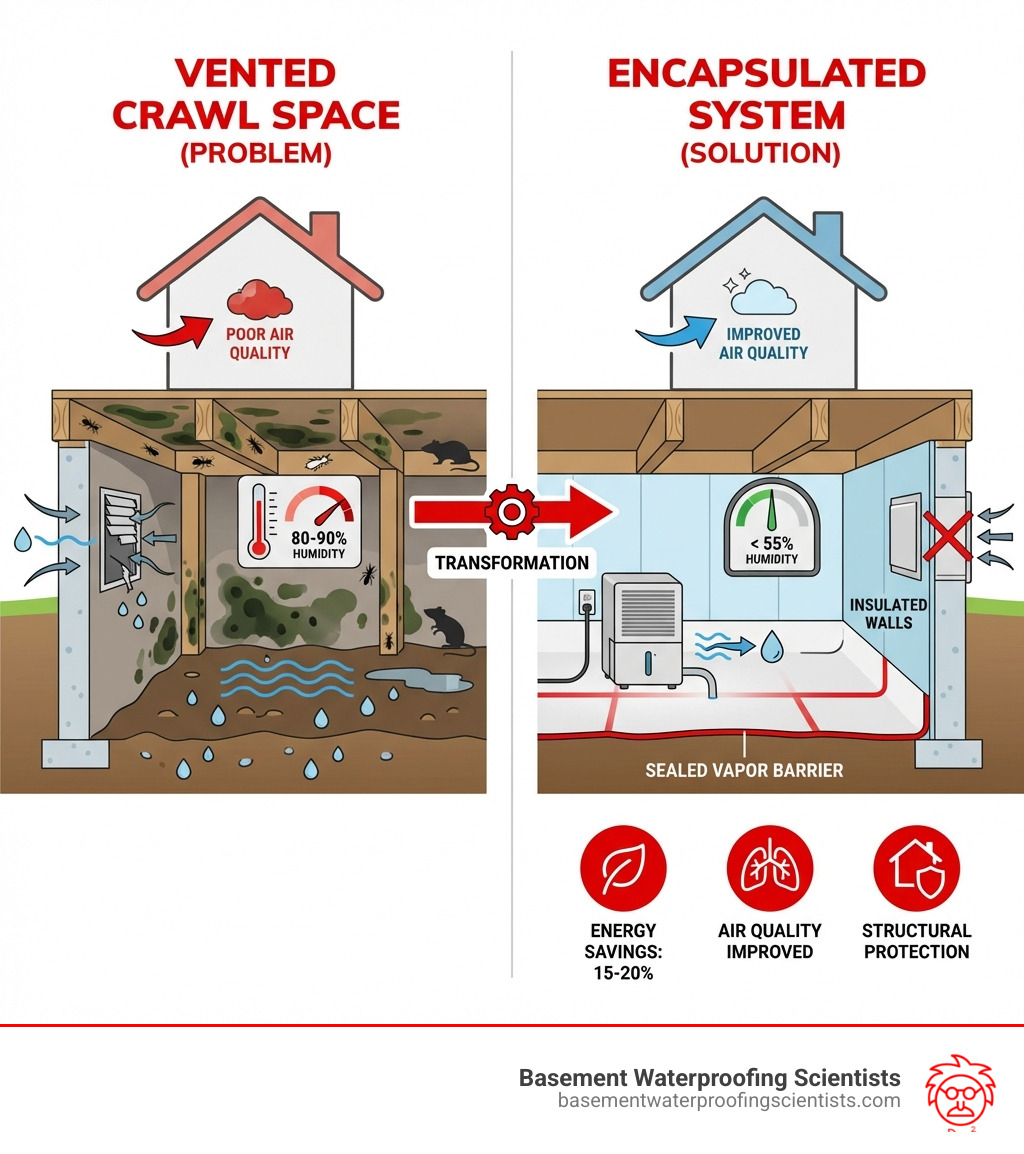
- Moisture Control: Reduces humidity from 80-90% down to 55% or lower, preventing mold growth
- Energy Savings: Cuts heating and cooling costs by 15-20% on average
- Air Quality: Improves indoor air since up to 50% of your home’s air originates from the crawl space
- Structural Protection: Prevents wood rot, floor sagging, and foundation damage
- Pest Prevention: Eliminates the damp environment that attracts termites, rodents, and insects
- System Longevity: Properly maintained encapsulation lasts 15-25 years
Research from Advanced Energy confirms that homes with sealed crawl spaces use an average of 20% less energy compared to vented ones. The process involves installing a heavy-duty vapor barrier (typically 10-20 mil polyethylene), sealing all vents and openings, insulating walls, and adding a dehumidifier to maintain optimal humidity levels.
Unlike simple vapor barriers that only cover the ground, full encapsulation creates a complete sealed environment. This addresses all four moisture transport modes: capillary action through porous materials, bulk moisture through cracks, air transport through penetrations, and vapor diffusion through permeable surfaces.
The investment typically ranges from $1,500 to $15,000 depending on square footage and existing conditions, but the benefits compound over time through lower energy bills, prevented repairs, and improved home value. For older homes especially, encapsulation can stabilize wood moisture content and prevent the expansion-contraction cycles that lead to structural issues.
I’m Darin Garvey, and over three decades of solving moisture problems in the Philadelphia area has shown me that crawl space encapsulation benefits homeowners most when they understand the science behind the solution and work with specialists who use advanced leak detection equipment. In this guide, I’ll walk you through exactly what encapsulation involves, the proven advantages backed by research, and how to determine if it’s the right choice for your home.
Crawl space encapsulation benefits word roundup:
What is Crawl Space Encapsulation and How Does It Work?
To understand how this system protects your home, we have to look at the “science” of the crawl space. For decades, the building code in Pennsylvania and New Jersey required crawl spaces to be vented. The idea was that air flowing through the vents would “dry out” the space. In reality, especially during our humid Mid-Atlantic summers, those vents do the exact opposite. They invite warm, wet air inside, where it hits the cool underside of your home and condenses into droplets—perfect for mold and rot.
Crawl space encapsulation is the process of completely sealing this area off from the outside world. We start with a high-quality crawl space liner installation using 20-mil polyethylene. This isn’t your average painter’s tarp; it’s a heavy-duty, reinforced material that acts as a permanent barrier against the earth.
The Mechanics of the Seal
The process works by addressing the four primary ways moisture enters your home:
- Capillary Action: Water wicking up through porous concrete and soil.
- Bulk Moisture: Rainwater or groundwater seeping through cracks.
- Air Transport: Humid air moving through vents and penetrations.
- Vapor Diffusion: Moisture passing through materials on a molecular level.
By sealing the floor and foundation walls, we create a “conditioned” space. We then use air sealing techniques to close off vents and gaps around pipes. Finally, we install thermal insulation (usually rigid foam on the walls) and a dedicated dehumidifier. This turns a damp, dark cavern into a clean, dry room that is essentially part of your home’s “envelope.”
Top 10 Crawl Space Encapsulation Benefits for Homeowners
When we talk to homeowners from Reading down to Delaware, they usually start by asking about mold. But once the job is done, they are often surprised by the other crawl space encapsulation benefits they experience.
- Humidity Regulation: We target a relative humidity of 55% or lower. Mold literally cannot thrive in these conditions.
- Structural Integrity: By keeping the wood dry, we prevent the “softness” that leads to sagging floors and costly structural repairs.
- Pest Deterrence: Termites and cockroaches need moisture to survive. A dry crawl space is a hostile environment for them.
- Increased Home Value: A sealed crawl space is a massive selling point that signals a well-maintained home.
- Equipment Longevity: If your HVAC unit or water heater is in the crawl space, it won’t rust out nearly as fast in a dry environment.
- Elimination of Musty Odors: That “old house smell” usually starts in the dirt under your feet.
- Floor Comfort: No more freezing toes in the winter; encapsulated spaces keep the subfloor at a consistent temperature.
- Usable Storage: Many of our customers in Pottstown and Bensalem use their encapsulated spaces for seasonal storage.
- Foundation Protection: Stabilizing the moisture in the soil helps prevent the soil from shifting and cracking your foundation.
- Radon Reduction: While not a total fix on its own, the sealed liner provides a critical first step in managing soil gases.
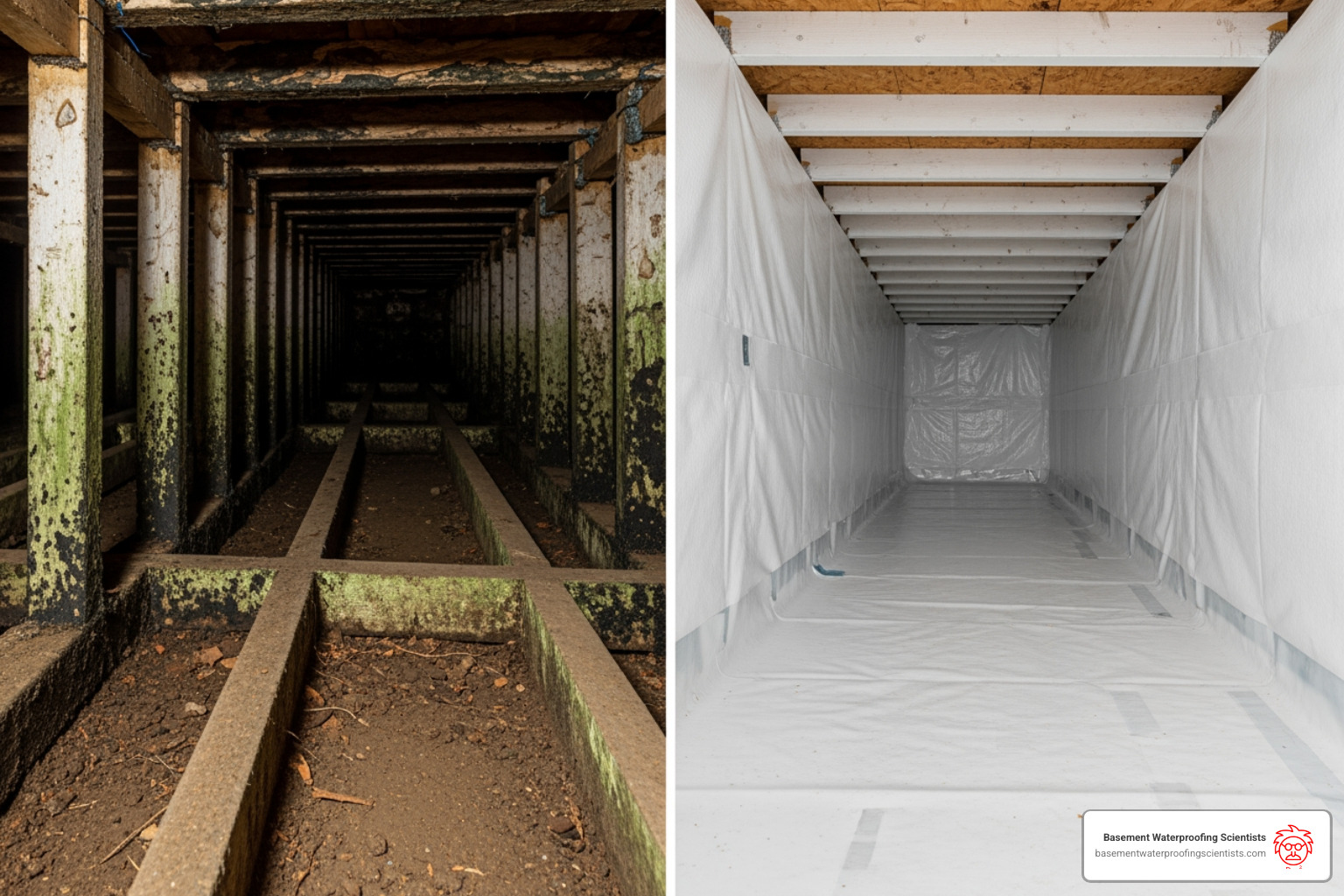
Vented vs. Encapsulated: A Comparison
| Feature | Vented Crawl Space | Encapsulated System |
|---|---|---|
| Humidity Levels | 70% – 90%+ | 45% – 55% |
| Air Quality | High mold/allergen risk | Clean, filtered air |
| Energy Use | Higher (HVAC works harder) | Lower (15-20% savings) |
| Pest Risk | High (Open invitations) | Low (Sealed entry points) |
| Floor Temperature | Drafty and cold | Warm and consistent |
Improved Indoor Air Quality and Crawl Space Encapsulation Benefits
One of the most important concepts we teach at Basement Waterproofing Scientists is the Stack Effect. Think of your house like a chimney. Warm air rises and escapes through the attic, creating a vacuum that pulls air from the lowest point of the house—the crawl space—up into your living area.
Research shows that as much as 50% of the air you breathe on the first floor comes directly from your crawl space. If that space is filled with mold spores, dust mites, and dampness, that’s what your family is breathing. By choosing basement and crawlspace waterproofing, you are essentially installing a giant air filter under your home.
This also plays a role in radon mitigation. Radon is an odorless, radioactive gas that moves up through the soil. While encapsulation is the first step, we often coordinate with radon specialists to ensure that any trapped gas is safely vented outside using “soil suction” techniques, keeping your indoor air safe and healthy, as recommended by the Environmental Protection Agency (EPA).
Maximizing Energy Efficiency and Energy-Saving Crawl Space Encapsulation Benefits
If you are tired of high utility bills in Philadelphia or King of Prussia, encapsulation is your new best friend. When your crawl space is vented, your HVAC system has to fight the outside temperature. In the summer, your AC is trying to cool a floor that is being baked by 90-degree humid air from the vents.
An encapsulated crawl space acts like a thermos. It keeps the air under your home at a stable temperature year-round. According to a study by Advanced Energy, homeowners can see an average of 20% less energy usage after sealing their crawl space. This not only saves you money but also extends the life of your furnace and AC unit because they don’t have to cycle as often. You can find more details on these long-term savings in our crawl space encapsulation cost guide.
Is Encapsulation a Worthwhile Investment for Older Homes?
We get this question a lot in historic areas like Ardmore and Bryn Mawr. “My house has been here since 1920; why do I need to seal it now?”
The truth is, older homes are often more susceptible to the damage caused by moisture. Decades of “venting” may have already started to take a toll on the original hand-hewn joists. One of the primary crawl space encapsulation benefits for older structures is the stabilization of the wood. When wood moisture content fluctuates, the wood expands and contracts, leading to cracks in plaster walls upstairs and doors that won’t shut.
By performing a crawl space repair NJ or PA homeowners can stop this cycle of decay. We use specialized equipment to identify exactly where moisture is entering—whether it’s a foundation crack or a plumbing leak—and fix it for less. For an older home, this isn’t just a “nice to have” upgrade; it’s a preservation tactic that ensures the house stands for another hundred years.
Potential Drawbacks and Safety Considerations
We believe in being 100% honest with our neighbors. While the benefits are massive, there are things you need to consider before jumping in.
- Initial Investment: The cost can be significant. While our average basement waterproofing runs between $4K and $8K, a full crawl space encapsulation can vary depending on the size and the need for extra drainage or mold remediation.
- Maintenance: You can’t just “set it and forget it.” The dehumidifier needs an annual check-up, and you should peek in once in a while to make sure no new plumbing leaks have started.
- Combustion Safety: If you have a natural-draft furnace or water heater in your crawl space, sealing the area can lead to back-drafting of carbon monoxide. We always check for “sealed combustion” units or ensure proper air intake is provided to keep your family safe, following U.S. Department of Energy safety protocols.
- Access: Once the white liner is in, it looks beautiful, but it can make accessing certain pipes a little more “delicate.” We always design our systems with access points in mind.
Frequently Asked Questions about Crawl Space Sealing
How much does crawl space encapsulation typically cost and what is the ROI?
The national average for encapsulation is around $5,000, but the range is wide—from $1,500 for a small area to $15,000 for a massive, complex space. When you consider that the cost to have vapor barrier installed is often offset by a 15-20% reduction in energy bills, the system often pays for itself within a few years. Plus, you’re avoiding the $10,000+ bill that comes with major structural wood rot repair.
What is the difference between a vapor barrier and full encapsulation?
Think of a vapor barrier as a raincoat and encapsulation as a full diving suit. A crawl space vapor barrier installation usually just involves laying plastic on the dirt floor. This helps, but it doesn’t stop humid air from coming through the vents or moisture from seeping through the walls. Full encapsulation seals the floor, the walls, the vents, and includes a dehumidifier to control the “climate” of the space.
How can I tell if my crawl space needs encapsulation?
Keep an eye (and a nose) out for these red flags:
- A persistent musty or “earthy” smell in your home.
- Buckled or “cupped” hardwood floors on the first floor.
- Condensation on your AC ductwork in the summer.
- High indoor humidity that your AC can’t seem to lower.
- Standing water or mud after a heavy rain in Willow Grove or Springfield.
- Visible mold on the floor joists.
If you see these signs, you likely need a crawl space drainage system and a full seal to protect your foundation.
Conclusion
At Basement Waterproofing Scientists, we don’t just throw plastic on the ground and call it a day. We use our 30 years of experience and specialized leak detection equipment to find the root cause of your moisture problems. Whether you are in Philadelphia, Norristown, or over the bridge in New Jersey, we provide customized solutions that are backed by a lifetime guarantee.
We know that every home is different, which is why we offer expert inspections to ensure you get exactly what you need—nothing more, nothing less. If you’re ready to experience the full range of crawl space encapsulation benefits, from lower bills to better health, we are here to help.
Don’t let a damp crawl space undermine your home’s value and your family’s comfort. Let’s get that space dry, clean, and sealed for good.
Ready to take the next step? Learn more about our basement moisture barrier installation and how we can protect your home from the ground up.