

Why Your Basement Needs a Comprehensive Moisture Defense Plan
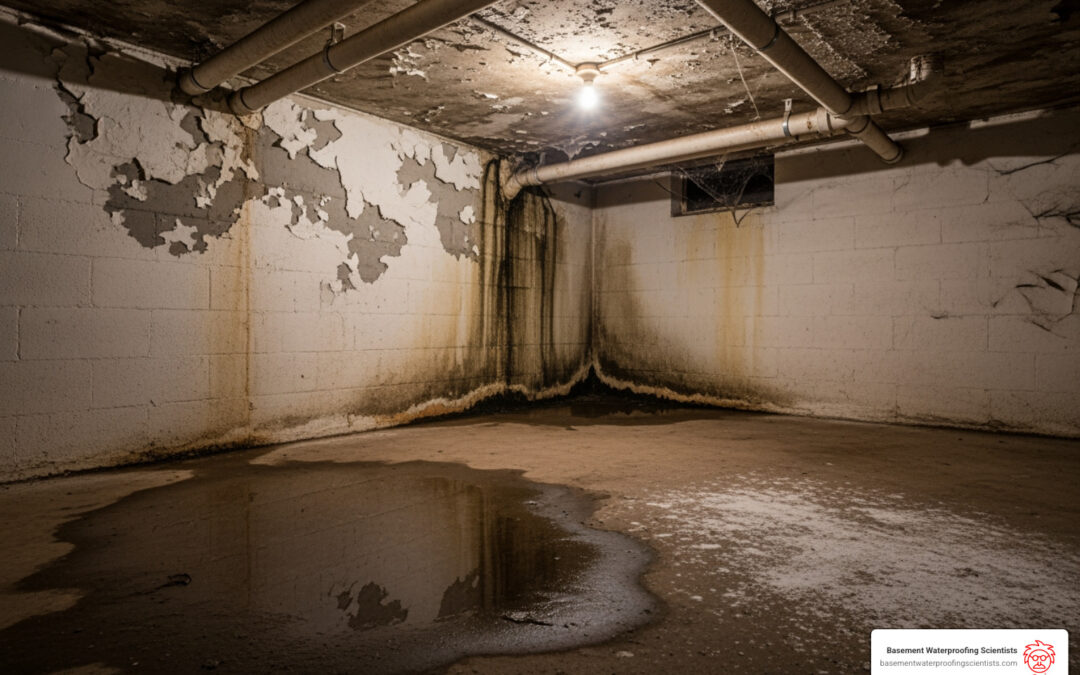
If you’ve noticed musty odors, damp spots, or a chalky white powder on your basement walls, you’re facing a moisture problem that won’t fix itself. Uncontrolled basement moisture leads to mold growth, structural damage, and can reduce your home’s value by up to 30%. The solution lies in basement moisture control systems—engineered solutions that prevent, capture, and remove water and humidity.
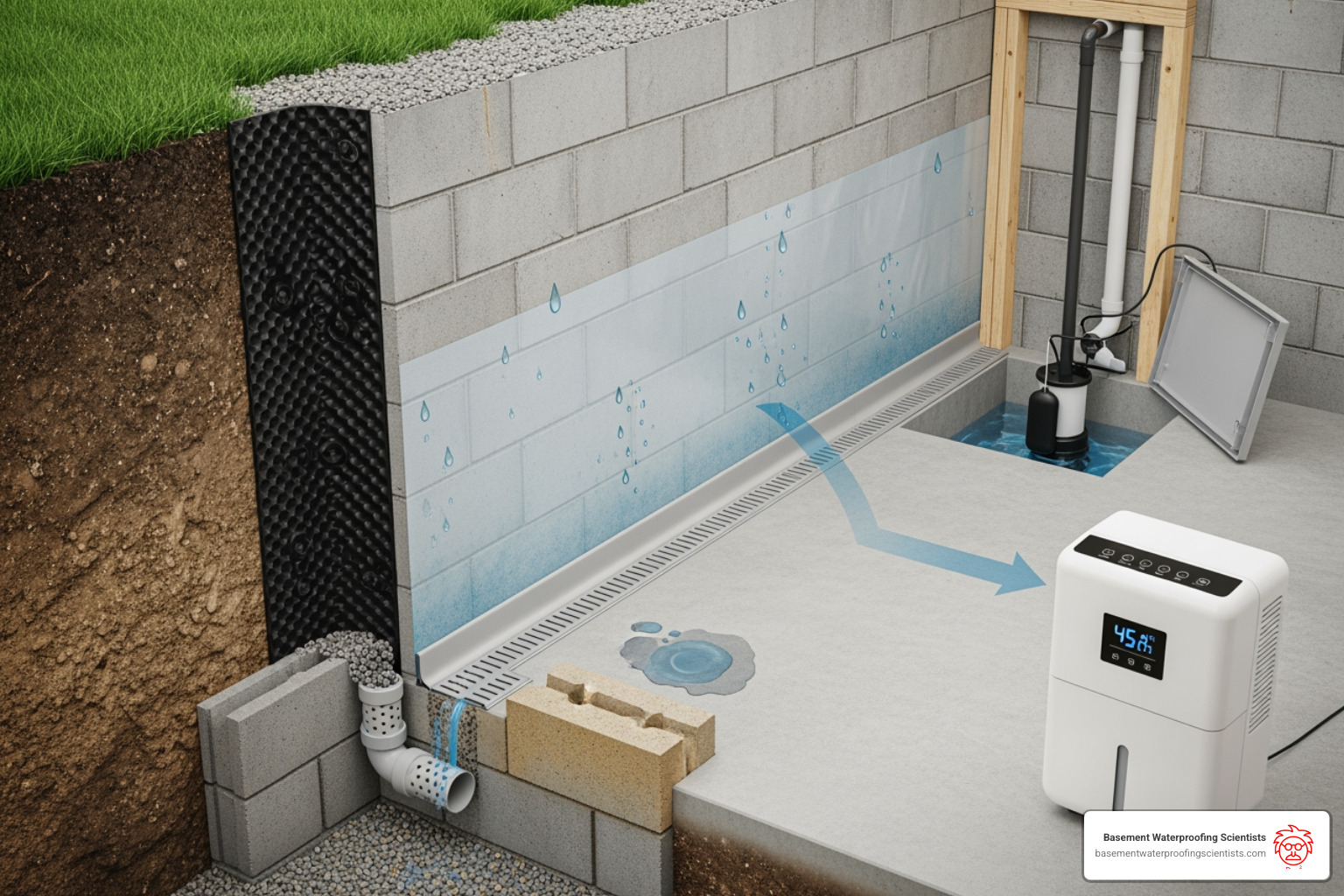
Core Components of a Moisture Control System:
- Interior Drainage: Captures groundwater at the floor-wall joint before it enters your living space.
- Sump Pumps: Remove collected water and discharge it safely away from your foundation.
- High-Efficiency Dehumidifiers: Control airborne moisture and filter pollutants from the air.
- Vapor Barriers: Block moisture migration through walls and floors.
- Exterior Drainage: Prevents water from reaching your foundation in the first place.
A truly effective strategy addresses water at its source. It’s not about temporary fixes; it’s about a permanent solution that transforms your basement into a dry, healthy space. Modern systems have a proven track record, with some installations still functioning perfectly after nearly 50 years.
I’m Darin Garvey, and with over 30 years in the basement waterproofing industry, I’ve seen how the right systems can solve even the most challenging water problems. At Basement Waterproofing Scientists, we help Philadelphia-area homeowners reclaim their basements with customized solutions that address their specific moisture challenges.
Understanding the Enemy: Common Sources of Basement Moisture
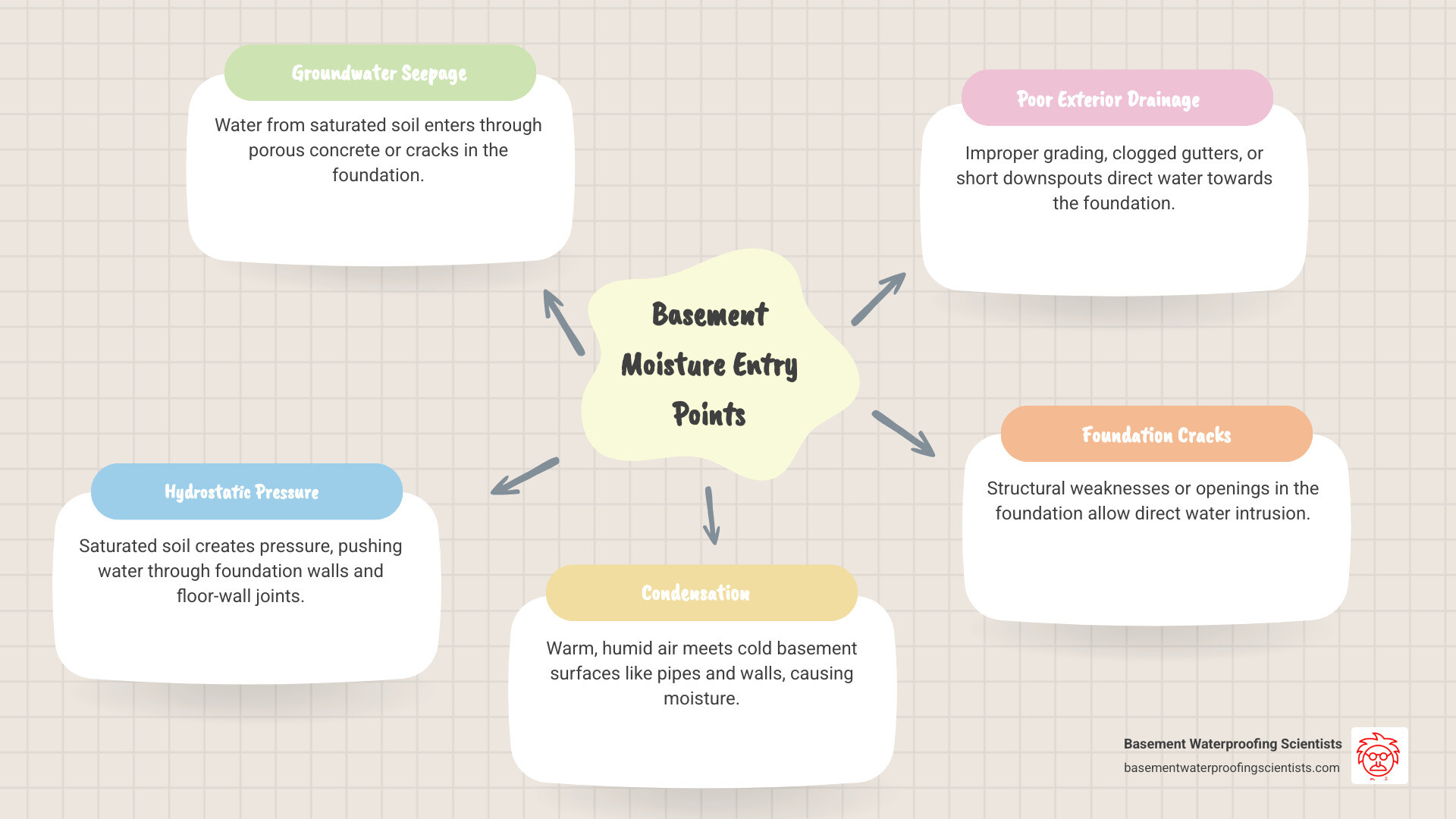
To defeat basement moisture, you must first identify its source. Water can infiltrate your below-grade space from multiple directions, often working in combination.
Groundwater seepage is the most common culprit. After rain or snowmelt, saturated soil creates hydrostatic pressure, a powerful force that pushes water against your foundation. This pressure exploits any weakness—hairline cracks, porous concrete, or the joint where the floor meets the wall. Just one inch of rain on a 2,000-square-foot roof can dump 1,250 gallons of water around your foundation, intensifying this pressure.
This is often worsened by the “clay bowl effect,” where the backfilled soil around your foundation acts like a sponge, trapping water against the walls.
Other common sources include:
- Condensation: Occurs when warm, humid air comes into contact with cool basement surfaces like walls and pipes, causing water vapor to condense into liquid droplets.
- Vapor Diffusion & Capillary Action: Moisture can pass directly through solid concrete as vapor or be wicked upward through microscopic pores, much like a paper towel soaking up a spill.
- Improper Exterior Drainage: If your yard slopes toward your house or your gutters and downspouts are clogged or too short, rainwater is directed right to your foundation.
For a deeper dive into moisture sources, the University of Minnesota Extension offers an excellent guide on Moisture in basements: causes and solutions.
The Dangers of a Damp Basement
A damp basement is more than an annoyance; it’s a threat to your home and health.
- Health Risks: High humidity creates a perfect breeding ground for mold and dust mites, two major indoor allergens that can trigger asthma, allergies, and other respiratory issues. The EPA suggests 6 to 8 air exchanges per day to combat these pollutants. Learn more about how wet basements create mold and why controlling moisture is key to reducing allergens.
- Structural Damage: Persistent moisture rots wooden support beams, causes concrete to crumble (spalling), and leaves behind mineral deposits (efflorescence). These are signs that your foundation is actively degrading.
- Reduced Home Value: A wet basement can slash your home’s market value. Buyers are wary of moisture issues, and lenders view them as a risk, complicating sales.
Your Defensive Strategy: A Guide to Basement Moisture Control Systems
An effective defense against basement moisture isn’t a single product but a coordinated team of solutions. A comprehensive approach combines drainage, dehumidification, and vapor control to create a permanently dry and healthy space. This layered strategy tackles water from the outside-in, addressing it at every potential entry point.
At Basement Waterproofing Scientists, we design custom systems that work in harmony to protect your home. Explore our full range of basement waterproofing solutions.
Exterior Waterproofing and Surface Drainage
Your first line of defense is stopping water before it reaches your foundation.
- Proper Grading: Ensure your yard slopes away from the house (at least 1 inch per foot for the first 6 feet).
- Gutters & Downspouts: Keep gutters clean and use extensions to discharge water at least 4-6 feet from your foundation.
- Exterior Drains: For more serious issues, an exterior French drain can be installed to intercept groundwater, though this is a more invasive process. Learn more about exterior foundation waterproofing.
Interior Basement Moisture Control Systems
For water that gets past exterior defenses, an interior system is your essential backup. This is often the most cost-effective and least disruptive solution.
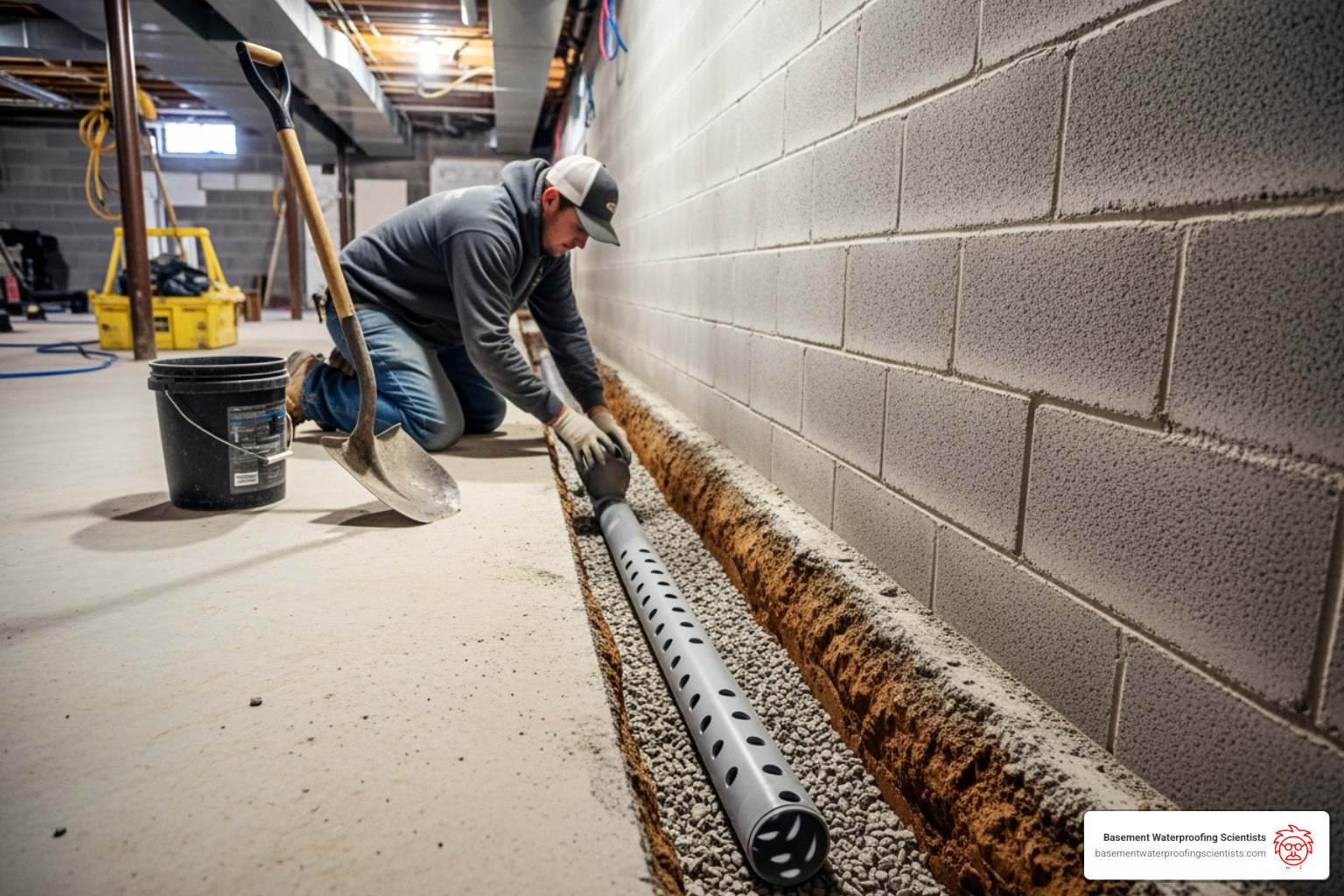
The core of this system is an interior drainage channel installed along the floor-wall joint. This clog-free system captures water at its most common entry point and directs it to a sump pump. The pump then safely discharges the water away from your home. This relieves hydrostatic pressure and keeps your floor dry. We often pair this with a vapor barrier on the walls to direct any seepage into the drain. Find the details of installing an interior drain tile system.
Atmospheric Basement Moisture Control Systems
Even with perfect drainage, you must control airborne moisture (humidity). A standard household dehumidifier is no match for basement conditions.
We install high-efficiency dehumidifiers engineered for basements. These powerful units remove far more moisture than standard models while using less energy. Key features include:
- Self-Draining: They connect directly to your sump pump, so you never have to empty a bucket.
- Air Filtration: They trap mold spores, dust, and other allergens, improving air quality throughout your home.
- Automatic Humidity Control: A built-in humidistat maintains the ideal humidity level (between 30-50%) to prevent mold growth.
This final step transforms your basement into a comfortable, healthy environment. See how you can achieve basement air quality improvement.
Choosing Your Solution: Professional Installation for Lasting Results
While some minor DIY fixes exist, most basement moisture problems require the expertise and specialized equipment of a professional. Your home’s foundation is too important for guesswork. A professional installation ensures the problem is diagnosed correctly and solved permanently.
At Basement Waterproofing Scientists, our 30 years of experience have shown us what works. We use scientific diagnosis to pinpoint the source of water entry, allowing us to design a targeted, cost-effective solution.
| Benefit of Professional Installation | Why It Matters |
|---|---|
| Expert Diagnosis | Uses specialized equipment to find the true source of the leak, saving you money on unnecessary work. |
| Custom Solutions | Your system is designed for your home’s specific issues, ensuring effectiveness. |
| Faster Installation | Experienced crews can often complete the job in 1-2 days with minimal disruption. |
| Long-Term Performance | Professional-grade materials and techniques mean the fix is permanent, not a temporary patch. |
| Lifetime Warranty | Provides complete peace of mind, protecting your investment and adding value to your home. |
The average cost for professional waterproofing ranges from $4,000 to $8,000, an investment that protects your home for decades. For more details, see our guide on basement waterproofing costs.
When to Call a Professional
It’s time to call an expert if you see:
- Complex Water Issues: Water entering from multiple or unknown sources.
- Structural Cracks: Horizontal cracks, or any crack wider than 1/8 inch, can indicate foundation stress.
- High Water Table: If your property is in an area with consistently saturated soil, you need a robust system to manage constant hydrostatic pressure.
- Moisture in a Finished Basement: Professionals can often install a system with minimal disruption to your finished space.
For issues involving structural integrity, explore our foundation repair and waterproofing services.
The Importance of a Lifetime Warranty
A warranty is only as good as the company behind it. Our lifetime warranty is our commitment to you and includes:
- Product & Labor Coverage: We stand behind both the materials we use and the quality of our installation.
- Transferable Protection: If you sell your home, the warranty transfers to the new owner, adding significant value.
- Long-Term Peace of Mind: We’ve been in business for 30 years and plan to be here for 30 more. Our warranty ensures you’ll never have to worry about your basement moisture problem again.
Learn more about our basement waterproofing lifetime warranty.
Introduction
Musty odors, peeling paint, damp air, and white efflorescence are all warning signs that moisture is finding its way into your basement. Left alone, these issues can damage finishes, invite mold, and erode your homes value. This article explains where moisture comes from, how to stop it with basement moisture control systems, and how to turn your lower level into a dry, healthy living space.
Understanding the Enemy: Common Sources of Basement Moisture
Basement leaks usually start with groundwater seepage. After rain or snowmelt, saturated soil builds hydrostatic pressure against your walls and slab, forcing water through hairline cracks, porous concrete, and the floor-wall joint. Moisture can also come from:
- Condensation when warm, humid air meets cool basement surfaces.
- Interior sources (showers, laundry, cooking) that raise indoor humidity.
- Capillary suction and vapor diffusion that draw or move moisture through concrete and masonry.
- Air leakage and the stack effect, pulling moist outdoor air in at rim joists and penetrations.
- Improper exterior drainage (poor grading, short downspouts, overloaded window wells).
For a deeper primer, see the University of Minnesota Extensions guide on Moisture in basements: causes and solutions.
The Dangers of a Damp Basement
- Health risks: Moist conditions fuel how wet basements create mold and dust mites, which can aggravate allergies and asthma. Controlling moisture is key to reducing allergens.
- Structural damage: Persistent moisture leads to spalling concrete and efflorescence, signaling ongoing deterioration.
- Reduced home value: Visible moisture problems deter buyers and complicate financing.
Your Defensive Strategy: A Guide to Basement Moisture Control Systems
Effective protection combines drainage, vapor control, and dehumidification. We design integrated systems custom to your home. Explore our full range of basement waterproofing solutions.
Exterior Waterproofing and Surface Drainage
- Proper grading: Slope soil away from the foundation at least 1 inch per foot for the first 6 feet.
- Gutters and downspouts: Keep gutters clear; extend downspouts 4-6 feet from the foundation.
- Exterior drains and membranes: In persistent cases, use exterior French drains and waterproofing membranes. Learn more about exterior foundation waterproofing.
Interior Basement Moisture Control Systems
- Interior drainage: Install a clog-resistant perimeter drain at the floor-wall joint to capture seepage.
- Sump pump: Discharge collected water safely away from your home.
- Vapor barriers: Line walls to direct seepage into the drain. See details on installing an interior drain tile system.
Atmospheric Basement Moisture Control Systems
- High-efficiency dehumidifiers: Self-draining, with robust filtration and automatic humidistats to maintain 30-50% RH. Learn more about basement air quality improvement.
Choosing Your Solution: Professional Installation for Lasting Results
Professional diagnosis and installation deliver faster, longer-lasting results than piecemeal fixes. Our specialized equipment pinpoints leak sources so we can tailor systems and often fix leaks for less. Benefits include:
- Expert diagnosis that targets the true source of moisture
- Custom system design for effectiveness and value
- Quick installation with minimal disruption
- Durable materials and methods for long-term performance
- Strong warranties for peace of mind
For typical price ranges and what influences cost, see our guide on basement waterproofing costs.
When to Call a Professional
- Complex water entry or multiple sources
- Structural cracks or signs of stress
- High water table or frequent storms
- Moisture in finished spaces
For issues involving structure, explore our foundation repair and waterproofing services.
The Importance of a Lifetime Warranty
- Product and labor coverage
- Transferable protection to future owners
- Long-term support from a stable, local company
Learn more about our basement waterproofing lifetime warranty.
Frequently Asked Questions about Basement Moisture
With three decades of experience, I’ve answered nearly every question about wet basements. Here are the most common ones.
What are the first signs my basement has a moisture problem?
Your senses are often the first to detect a problem. Look out for:
- Musty Smells: A damp, earthy odor is a classic sign of moisture and potential mold.
- Visible Mold: Black, green, or white spots on walls, joists, or stored items.
- Damp Spots: Darkened areas on concrete walls or floors, especially after rain.
- Peeling Paint: Bubbling or flaking paint indicates moisture trapped behind it.
- Efflorescence: A white, chalky powder on masonry surfaces left behind by evaporating water.
- High Humidity: A clammy, sticky feeling in the air, often with condensation on pipes or windows.
Is a dehumidifier enough to solve my basement moisture problem?
Rarely. A dehumidifier is an excellent tool for controlling airborne moisture (humidity), but it only treats a symptom, not the root cause. If you have active leaks or groundwater seeping in, a dehumidifier will run constantly without ever solving the problem. It’s a crucial part of a comprehensive system, but it cannot replace proper drainage and waterproofing.
How much does a basement moisture control system cost?
Costs vary based on your basement’s size, the severity of the issue, and the required solutions. While a minor exterior grading fix might cost a few hundred dollars, a full interior drainage system with a sump pump typically costs between $4,000 and $8,000. This is a permanent investment in your home’s health and value. Our expert diagnosis ensures we recommend only what you need, often fixing leaks for less than you’d expect. For a detailed breakdown, review our guide on budgeting for basement waterproofing costs.
Reclaim Your Basement for Good
You now understand what it takes to fix your damp basement permanently. A dry basement isn’t just about comfort; it’s about protecting your home’s value, creating a healthier environment for your family, and reclaiming valuable square footage.
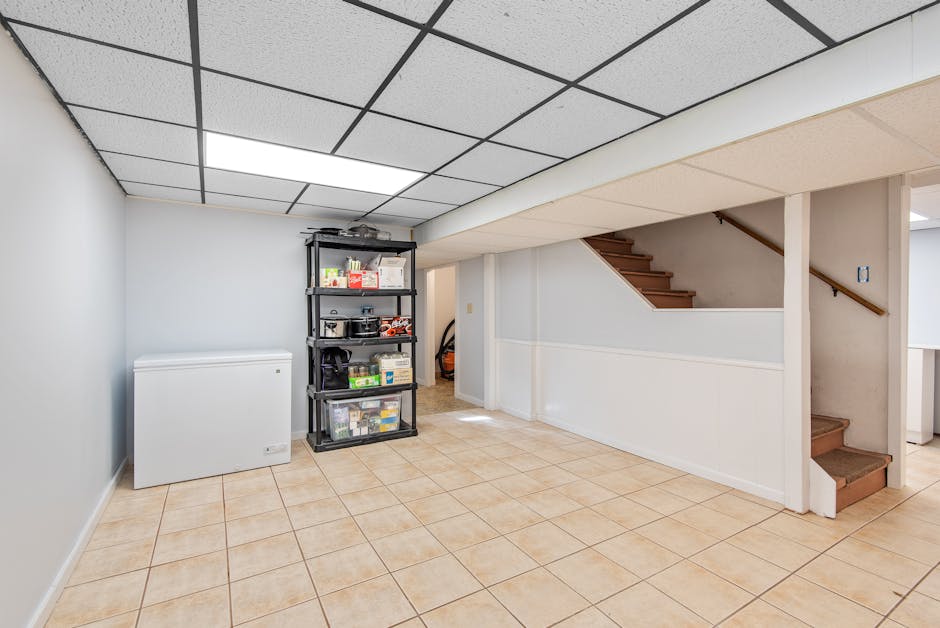
Imagine changing that damp storage area into a home office, playroom, or gym. By controlling moisture, you eliminate the breeding ground for mold and dust mites, and studies show proper waterproofing can boost home value by an average of 30%.
Permanent results require a comprehensive, professional approach custom to your home’s unique challenges. At Basement Waterproofing Scientists, we start with an expert inspection, using specialized equipment to pinpoint the exact source of water entry. This scientific approach allows us to design a targeted system and often fix leaks for less.
Our integrated systems provide a layered defense that ensures lasting results, all backed by a lifetime transferable warranty. You’re not just solving today’s problem; you’re making a long-term investment in your home.
Your basement doesn’t have to be a space you avoid. It can be dry, comfortable, and useful. The question isn’t whether you can reclaim it—it’s when you’re ready to take the first step.
Ready to install a permanent moisture barrier? Get your free estimate today!