

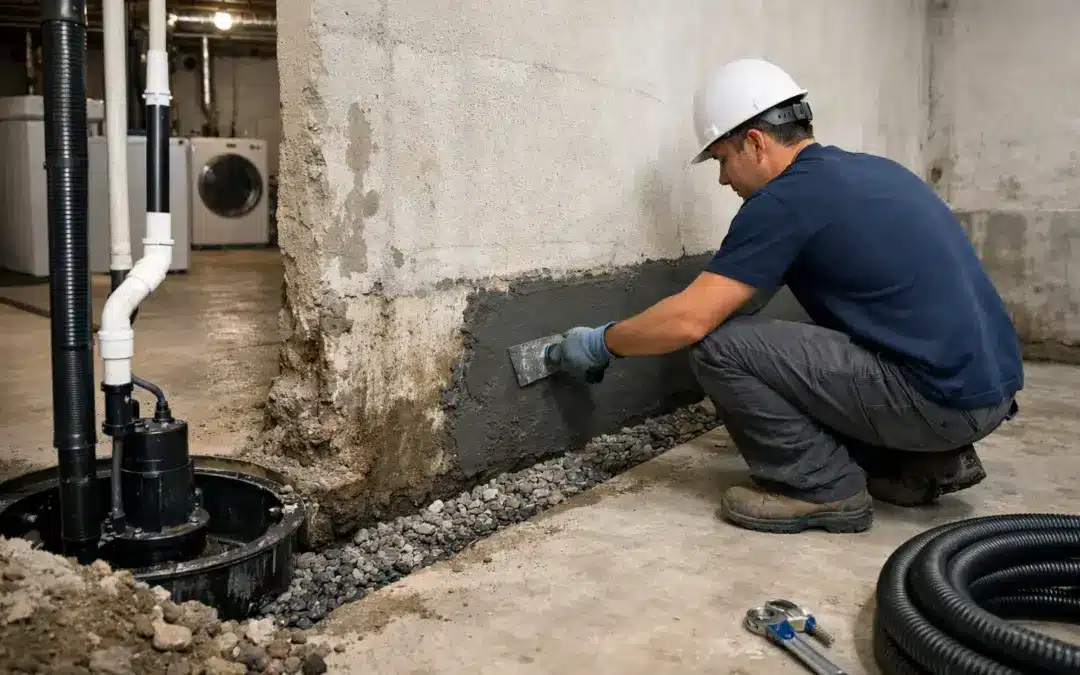
A wet basement in a Philadelphia-area rowhome rarely starts as a dramatic flood. More often, it is a dark line at the bottom of a party wall, a damp patch after heavy rain, peeling paint near the front steps, or a musty smell that returns every summer. Effective rowhome basement seepage repair begins by identifying exactly where that water is entering – not by covering the symptom with a generic waterproofing system.
Rowhomes have distinct foundation conditions. Their narrow lots, adjoining walls, aging masonry, limited exterior access, and closely packed drainage patterns can create water paths that are easy to miss. The right repair may be straightforward, but it has to match the actual source of the moisture.
Why Rowhome Basements Develop Seepage
Many rowhomes in Greater Philadelphia, Southeast Pennsylvania, and Southern New Jersey were built decades ago, often with stone, brick, or concrete foundations that have endured long-term soil pressure and seasonal water exposure. Materials age, mortar joints deteriorate, and small cracks can become direct routes for groundwater.
Rainwater is a common trigger, but it is not always the whole story. Water may enter where the front foundation meets a sidewalk, through a crack concealed behind finished walls, at a rear basement stairwell, or along the joint where the floor meets the foundation wall. A neighbor’s downspout, sloped pavement, blocked street drainage, or a high water table can also change how water moves around a tightly spaced rowhome block.
The location of the dampness offers clues, but it does not provide a diagnosis by itself. Water can travel through masonry and along framing before becoming visible somewhere else. A wet rear wall, for example, does not automatically mean the rear yard is the source.
The Most Common Water Entry Points
A thorough inspection should look beyond the obvious stain. In rowhomes, seepage frequently develops at foundation wall cracks, deteriorated mortar joints, floor-to-wall joints, utility penetrations, window wells, basement entry doors, and around old plumbing openings. In some homes, water is also pushed upward through the slab when groundwater pressure rises.
Front basement walls deserve close attention. Sidewalks and stoops often sit directly against the home, leaving little room for traditional exterior drainage work. When joints crack or settlement creates a gap, rainwater can collect at the foundation and migrate inward.
Party walls require a more careful assessment. Because neighboring properties share walls and are built close together, access may be restricted and water movement can be complex. The repair should address your home’s confirmed leak path without assuming that a large, expensive system is the only answer.
Rowhome Basement Seepage Repair Starts With Diagnosis
The best repair is the one that solves the documented problem with the least unnecessary work. That means finding the water source, evaluating the foundation materials, checking drainage conditions, and determining whether the issue is isolated seepage or a broader groundwater problem.
A professional inspection may include detailed visual evaluation, moisture assessment, crack analysis, and leak detection scanning. This approach can help distinguish between active water intrusion, condensation, plumbing leaks, and old staining from a past event. Those distinctions matter. Installing interior drainage for a leaking pipe will not fix the pipe. Sealing a visible crack may not solve water entering several feet away and traveling through the wall.
At Basement Waterproofing Scientists, the goal is to prescribe a targeted, economical repair based on the source of the moisture. Homeowners should be wary of recommendations that are made before anyone has identified where the water is actually coming from.
When Crack Repair Is the Right Solution
If water is entering through a defined vertical, horizontal, or stair-step foundation crack, targeted crack repair can be highly effective. The proper material and method depend on the crack, the foundation type, and whether the crack is actively moving or simply allowing water through.
A crack in poured concrete is evaluated differently from separation in an older stone or masonry foundation. In some cases, sealing from the interior is appropriate. In others, exterior access, drainage correction, or structural evaluation may be necessary. The important point is that a crack should not be treated as cosmetic when it is actively leaking.
When Interior Drainage Makes Sense
Interior drainage can be an excellent long-term solution when water is entering at the floor-wall joint or rising through the slab due to hydrostatic pressure. Properly installed systems collect water beneath or beside the floor edge and direct it to a sump pump for discharge away from the foundation.
This is not automatically the correct answer for every damp basement. It is most useful when the issue involves persistent groundwater pressure or widespread seepage that cannot be reliably controlled at one exterior entry point. A targeted system may be enough in a rowhome, while other properties need a more extensive perimeter approach.
When Exterior Repairs Are Worth Considering
Exterior waterproofing and drainage repairs can stop water before it reaches the foundation wall. They can be a strong option around accessible rear walls, basement entries, window wells, or localized sections where surface water is clearly being directed toward the home.
The trade-off is access. Excavation near a sidewalk, stoop, driveway, or shared property line may add cost and complexity. That does not make exterior work wrong. It simply means the benefits should be weighed against a less invasive repair that addresses the same confirmed source.
Do Not Confuse Seepage With Condensation
A humid basement can produce damp walls, sweating pipes, and musty odors even without outside water entering the foundation. Condensation commonly appears during warm, humid weather when moist air meets cool basement surfaces. It can look alarming, especially on masonry walls.
Seepage usually follows rainfall, snowmelt, or periods of saturated soil. It may leave water trails, mineral deposits, peeling paint, or wet spots at predictable locations. Condensation tends to be more widespread and seasonal, especially near uninsulated pipes and cool walls.
Both conditions can contribute to mold growth and poor indoor air quality. However, they require different solutions. Dehumidification may control condensation, but it will not repair a leaking foundation. Likewise, waterproofing alone may not solve humidity issues in a poorly ventilated basement.
What Happens When Repairs Are Delayed
A small leak is easy to postpone because it may only appear during severe storms. The problem is that repeated wetting gradually damages more than paint or stored belongings. Moisture can weaken mortar, deteriorate wood framing, corrode metal components, and create conditions that support mold.
For homeowners who use the basement for storage, laundry, finished living space, or a workshop, recurring seepage also limits how safely the space can be used. If water reaches electrical equipment, a furnace area, or a finished wall, the cost of cleanup can quickly exceed the cost of an earlier repair.
Structural concerns deserve prompt attention as well. Not every crack is structural, but widening cracks, bowing walls, displaced masonry, or repeated water intrusion should be professionally evaluated rather than patched over.
How to Protect a Rowhome Basement Between Inspections
Homeowners can reduce surface-water risk by keeping gutters clear, extending downspouts where practical, and watching how water moves near the front stoop, rear yard, and basement entry after rain. Avoid storing cardboard, fabrics, or valuables directly on the basement floor. If the basement has a sump pump, test it regularly and make sure its discharge line directs water away from the foundation.
Do not rely on waterproof paint as a permanent repair for active seepage. It may temporarily improve appearance, but pressure behind the wall can cause coatings to blister or peel. Caulk can also fail when used on an active or moving crack without addressing the conditions around it.
Photographs are useful. Take pictures when water first appears, note whether it follows rain, and record the location. That information can help a specialist identify patterns during a free inspection.
Choose a Repair Plan That Fits the House
There is no single correct rowhome basement repair. A localized foundation crack may need a focused repair. Persistent floor-edge seepage may call for interior drainage and a sump pump. A leaking basement entry may need drainage correction and an improved door solution. The right plan depends on the source, the foundation construction, access conditions, and how the basement is used.
A permanent solution should be clear about what it fixes, why that method is recommended, and what guarantee supports the work. When the moisture path is accurately diagnosed, homeowners can avoid paying for unnecessary work and move forward with confidence.
If your basement has started showing water stains, damp walls, or a recurring musty odor, schedule an inspection before the next heavy rain turns a manageable problem into a larger repair. A precise diagnosis now can protect the home, the basement, and your budget for years to come.