

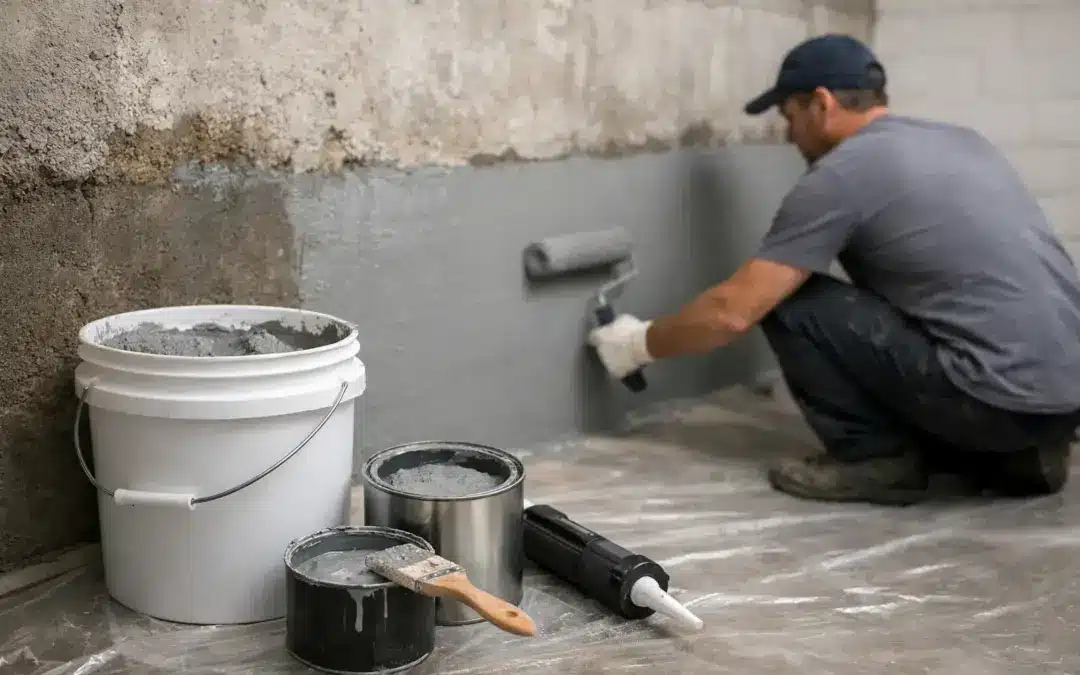
A painted basement wall that still feels damp a week later is usually telling you something simple – the coating was never the real fix. If you are asking what is the best product to waterproof basement walls, the honest answer is that the best product depends on why the wall is getting wet in the first place. Water stains, peeling paint, white chalky residue, and active seepage can all look similar, but they point to very different problems.
That is where many homeowners get burned. They buy a bucket of waterproofing paint, roll it onto the wall, and expect a permanent result. Sometimes it slows surface moisture for a while. Just as often, it traps moisture, blisters, or fails because hydrostatic pressure is pushing water through the wall, floor joint, or a crack the coating cannot actually repair.
What is the best product to waterproof basement walls? Start with the water source
Basement wall waterproofing is not really a single-product decision. It is a diagnosis problem first. If moisture is coming through porous masonry, one type of treatment may help. If water is entering through a wall crack, cold joint, tie rod hole, or exterior grading issue, a coating alone is the wrong answer.
In homes across Greater Philadelphia, Southeast Pennsylvania, and South Jersey, we often see older block and stone foundations, aging mortar joints, and exterior drainage conditions that create recurring moisture pressure. In those cases, the best product is often not a paint at all. It may be a crack injection material, a masonry sealer used in the right setting, or part of a larger drainage correction plan.
A good rule is this: if the wall is merely humid or slightly damp, surface-applied products may have a role. If water is actively entering, staining repeatedly, or pushing material off the wall, you are likely dealing with a structural or drainage issue that needs more than a coating.
The most common waterproofing products for basement walls
Homeowners usually compare a few categories. Each has a place, but none is universally best.
Waterproofing paint and masonry coatings
These are the products most people see first at the hardware store. They are marketed as quick wall waterproofers and can help in mild cases where moisture transmission is limited and the wall surface is sound.
The problem is that they are often used far beyond what they can handle. If your basement wall has active seepage, lateral pressure, or cracks, paint-on coatings are usually a cosmetic delay, not a permanent fix. They may also fail quickly on walls with existing efflorescence, loose material, or prior coatings.
For a dry basement with only slight vapor transfer, a quality masonry coating can be part of the solution. For a leaking basement, it is rarely the whole solution.
Silicate concrete and masonry sealers
Silicate-based sealers penetrate masonry rather than sitting only on the surface. On the right substrate, they can reduce moisture transmission and strengthen porous surfaces. They are generally a better option than basic waterproof paint when the wall is structurally sound and the issue is minor dampness rather than active water entry.
The trade-off is that they still do not fix moving cracks, failed joints, or exterior water buildup. They can support a waterproofing strategy, but they cannot overcome serious pressure pushing water through the wall system.
Polyurethane and epoxy crack injection products
If water is entering through a specific crack, the best product may be a crack injection resin rather than a wall coating. Polyurethane injections are commonly used when a crack is actively leaking because they expand and can help stop water migration. Epoxy is often chosen when structural bond strength matters, though it is not always the best match for every wet crack condition.
This is where accuracy matters. A homeowner may think the whole wall is leaking when the actual entry point is one hairline crack that lets water spread across the interior surface. In that situation, sealing the crack correctly is far more effective than painting the entire wall.
Hydraulic cement and patching compounds
Hydraulic cement is often used to stop localized seepage around holes, small openings, pipe penetrations, and some joint areas. It sets quickly and can hold up well when used correctly.
Still, it is not a cure-all. It is a spot repair material, not a complete waterproofing system. If the surrounding wall is under ongoing pressure or the crack is moving, the repair may not last.
When the best “product” is actually an interior drainage system
This is the part many articles skip. Some basement wall leaks are not wall-product problems at all. They are water management problems.
If groundwater is building up around the foundation, the permanent fix may involve relieving that pressure with interior drainage, a sump system, or exterior corrections. In those cases, asking what is the best product to waterproof basement walls is a little like asking what paint fixes a roof leak. The product is not the main issue. The path of water is.
A wall coating cannot reliably beat constant hydrostatic pressure. It may hide the symptoms for a short time, but it does not change what the water is doing outside or beneath the foundation.
How to tell which basement wall product fits your situation
You do not need to be an engineer to spot the difference between a coating-level problem and a system-level problem. A few signs can point you in the right direction.
If your walls feel cool and slightly damp but you do not see running water, you may be dealing with condensation or low-level moisture transfer. In that case, a penetrating masonry sealer may help, along with humidity control.
If you see white powder, bubbling paint, or recurring stains in the same area after storms, there is a strong chance water is entering through the wall assembly. That usually calls for better diagnosis before choosing any product.
If you notice a vertical, diagonal, or stair-step crack, especially one that leaks during heavy rain, the best product may be a professional crack repair material such as polyurethane injection.
If water shows up at the base of the wall where it meets the floor, the issue is often pressure under or around the foundation, which points more toward drainage than wall paint.
What usually works best in real basements
For most leaking basement walls, the best results come from matching the repair to the failure point. That sounds obvious, but it is exactly what gets missed when a contractor pushes the same system for every house or when a homeowner tries to solve everything with one shelf product.
A dry, structurally sound poured concrete wall with minor dampness may respond well to a penetrating sealer. A single leaking crack may be best handled with targeted injection repair. A block wall with repeated seepage and exterior water pressure may need drainage and wall-specific reinforcement measures. An old stone foundation may require a different moisture management approach entirely.
That is why a science-driven inspection matters. The goal is not to sell the biggest job. The goal is to identify where the water starts, how it travels, and what repair will actually stop it for the lowest sensible cost.
Mistakes homeowners make when choosing waterproofing products
The biggest mistake is treating all moisture as the same problem. Damp air, condensation, capillary transfer, crack leakage, and hydrostatic pressure can all leave the wall looking wet. They are not fixed the same way.
Another common mistake is applying waterproof paint over a wall that has not been properly prepared. If the surface still has efflorescence, loose paint, or hidden water pressure, the coating is set up to fail.
The third mistake is assuming the wall is the source because that is where the water shows. Water can travel from the footing, from an exterior grading defect, from a window well, or from a tiny crack several feet away from the visible stain.
So, what should you buy?
If you have very minor moisture on an otherwise sound basement wall, a high-quality penetrating masonry sealer is usually a better bet than basic waterproof paint. If you have a visible crack that leaks, the right repair product is more likely a professional injection material. If you have active seepage, repeated storm-related water, or water at the wall-floor joint, buying a coating is probably not buying the fix.
The best product to waterproof basement walls is the one that matches the real cause of the leak. Sometimes that is a sealer. Sometimes it is crack injection. Sometimes it is hydraulic cement in a specific area. And sometimes the right answer is not a wall product at all, but a drainage correction that takes the pressure off the foundation.
At Basement Waterproofing Scientists, that is exactly how we approach it – diagnose first, prescribe second, and fix only what needs to be fixed. If your basement walls keep getting wet, the smartest next step is not guessing better. It is finding out exactly why the wall is wet so the repair lasts.
A basement does not need a miracle product. It needs the right solution for the way water is moving through your home.